Tuesday, June 24, 2014

DNA secret revealed

We're all equal, it's simply true, that is science
James Watsondiscovered DNA structure  (born April 6, 1928) along with his partner Francis Crick in 1953.
The nobel prize winning (1962) American molecular biologist, is also known for his critical remark, in which he has said that Africans are less intelligent.
"We're not all equal, 
it's simply not true,
that isn't science." he said.
Photo: ADAM NADEL
He was suspended over racial remarks.
Watson was embroiled in an extraordinary row. 
He retired as chancellor of Cold Spring Harbor Laboratory near New York City, for which he was Chancellor for continuous 39 years.

What an irony; in his own DNA genetic test in December 2007, it was found that 16 of his genes are likely to have come from a black ancestor; while in European community such gene is found not more than 1 in number. 
It means something like as if his great grand father was African.
DNA model by Watson

Vian Joseph from Louisiana is a black American.
He has written articles in famous magazine News Week, on the problems of blacks.
He believed that he is 70% African and 30% some other race
due to hybridization of generations of his mother and father.
But when he got his DNA genetic test done for ethnicity, he was told that he is 57% Indo-European, 39% American Indian and 41% East Asian.
He did not had African blood at all. 
(reference courtesy:gyanendra mishra, science reporter/february 2014)

These are the example that our own phenotype is not our right identification.
If we are identified on the basis of generations of our mother and father
and if we go back in time some 200,000 years ago,
then almost all scientist believe that 
the whole human community is a member of one family.

Modern human (Homo sapiens) originated in African continent
and their ancestors are still there, 
as South African San and Vianca pygmy of Central Africa.
We are their direct descendants, 
who are still there living gracefully....!!

links of some related post:

Tuesday, June 17, 2014

Age of 'human-civilization'

(Homo sapiens
began about 50,000-80,000 years ago from Africa to Asia.
courtesy:http://www.politicalforum.com/current-events/
206817-hints-earlier-human-exit-africa.html

Toba super-eruption and Indian subcontinent, scientists from India, Britain, USA and Australia in an article in Science of 6 June 2007* have given evidence of modern human (Homo sapiens) presence in south India.
courtesy:http://www.sciencemag.org/
content/317/5834/114/suppl/DC1


They have studied ash buried in India 74,000 years ago, from the Toba super volcanic eruption of Indonesia. Their study site is a place Jwalapuram in Kurnool district of Andhra Pradesh, India. Eruption ashes flew from Indonesia and buried over a wider area of India, 2.5 meters in thickness in Jwalapuram. Age of the deposits were detected from the quartz particles there in. Age of the down most layer of ash deposit is about 77,000 years. This site in southern India shows that local human populations persisted through the cataclysmic Toba volcanic eruption 77,000 years ago.

courtesy:http://www.sciencemag.org/
content/317/5834/114/suppl/DC1
The stone artifacts found in this layer and upper layer, are having similarities. That means, prior and after the Toba Eruption, there is technical similarities in stone artifacts. Apart from that these technicalities are more near to  to the stone artifacts of Africa than the Eurasia. Scientists firmly believe that these evidences are the final proof that modern humans (Homo sapiens) were living in India at the time of Toba eruption and they were so capable that they could withstand this large scale environmental catastrophe and survived there after.


Human existence
Big bang occurred 14,000,000,000 years ago.
Out of 4,500,000,000 years of earth age, we humans have footprints on earth since last 200,000 of years.

We moved from Africa and landed somewhere in Indian sub continent some 77,000 years ago, before adopting different routes for Asia, Europe and America with an average speed of 3 kilomwters per years, setting human colonies at various places.

Since then, ocean has risen up with 100 meters, hardly left are any clues of our movement along the sea coast we traveled by.

Where are those 77,000 years we spent in times past ?

And what is the age of any civilization ?

Where are those 'cultural communities' or 'ages of development' or civilizations
This question most often comes to our mind.
Record of longevity of any known/unknown civilization hardly goes to few hundred or at the most 5 thousand years, with constructing and imaginative links we have to add to with archaeological findings.
Every civilization does have a life span of it's own.
And civilizations come to an end at some point, due some reason, gradually or abruptly.

'Human civilization' 
a new perspective
'Universality' is the new phenomenon of this century, more profoundly added to our vocabulary..a new tool for the perspective of all and everything we preserve dear to human, including values; ..a common and only reliable cause for our peaceful existence on this planet we call earth, ..our home !!

A look back to earth by Apollo 11 astronaut, changed our concept as 'earth became our home without borders'.

In this ever expanding (due to Dark Energy) infinite cosmos against the forces of attraction and gravity, our earth is like a particle of dust.

A  look at the 'Pale Blue Dot' by Voyager 1 launched in 1977 changed our concept once again, made us more humble, we come to know the universe beyond heliosphere, which is very big, cool and dark

Unseen cosmos is 10 times bigger than the seen cosmos of 'Dark Matter', which is a vital force affecting the movement of even distant stars of the Milky Way.

Other civilizations, beyond our 'human civilization'....
courtesy:http://voyager.jpl.nasa.gov/spacecraft/goldenrec.html
 Voyager 1 has taken voices and information from earth for the other civilizations of the beyond worlds.
Self life of Voyager 1 is 1,000,000,000 years.

Who knows, by that time we are lost in the vast darkness of the universe, as we were not here 1,000,000,000 years earlier and earth was not hospitable to our existence then.

Civilizations are lost due to,
1. Supernova i.e. death of a star, once in a billion years of time, harming cosmic rays.
2. Volcanic eruptions, causing volcanic winter (the one like Toba of Indonesiaof of 6–10 years and possibly a 1,000-year-long cooling episode; in which we survived)
3. Asteroid hit, happens only once in 1,000,000 years
4. Pathogens, Columbus took virus which was the reason of many mortality among Red Indians.
5. Eco system changes, which is hard to predict for times deep in future.
6. The one example of Iraq, where crop irrigation system caused the salt deposition in fertile soil gradually, causing to lose it's fertility in due course of time, and human colony deserted the place.

Our Potent protection,
Our intelligence is the only potent weapon of ours to protect this human species from the possible onslaught of any natural or human induced calamity or threat to our existence.

We the travelers,
Sometimes not an answer..
but a silence,
aboriginals saying,
a look at the night sky is all there;
to reward us with the inner peace..
as we need to comprehend the super designs of the higher reaches !!
pic credit:Kristina Buceatchi

 As an Australian Aboriginal proverb says;

“We are all visitors to this time, this place. We are just passing through. Our purpose here is to observe, to learn, to grow, to love... and then we return home.”


And as per our astronomical understandings;

"All matter is made of atoms that were originally created in the center of stars, so our eyes are actually looking back in time at the very things that created them in the first place when we look up at the night sky."..


We the sons and daughters of star....
There is no annihilation,
We turn in to light,
And light turns in to matter !!
(http://science.howstuffworks.com/environmental/earth/geophysics/can-we-manufacture-matter.htm)


*Science 6 July 2007
Vol. 317 no. 5834 pp. 114-116
Report
Middle Paleolithic Assemblages from the Indian Subcontinent Before and After the Toba Super Eruption
Michael Petraglia, Ravi Korisettar, Nicole Boivin, Christopher Clarkson, Peter Ditchfield, Sacha Jones, Jinu Koshy, Marta Mirazón Lahr, Clive Oppenheimer, David Pyle, Richard Roberts, Jean-Luc Schwenninger,Lee Arnold, Kevin White
Abstract
The Youngest Toba Tuff (YTT) eruption, which occurred in Indonesia 74,000 years ago, is one of Earth's largest known volcanic events. The effect of the YTT eruption on existing populations of humans, and accordingly on the course of human evolution, is debated. Here we associate the YTT with archaeological assemblages at Jwalapuram, in the Jurreru River valley of southern India. Broad continuity of Middle Paleolithic technology across the YTT event suggests that hominins persisted regionally across this major eruptive event.(http://www.sciencemag.org/content/317/5834/114.abstract)

Tuesday, June 3, 2014

Human history through genetics

History:  
Our traditional history books hardly tell anything about our primal history !!

Usually they start with the available history of some civilization (say Indus Valley civilization in Indian context, which was actually a city civilization), their possible place of initial movement (say central Asia, in this example, gene study also denies the possibility of Aryan influx in great numbers ) and other civilization (say Vedic, here) started later on their ruins, etc........
 
Human history:  
It is believed that modern human species, Homo sapiens origins about 160,000 to 200,000 years ago from then Homo erectus species from a small group in African continent. 
Gradually this species of ours obliterated Homo erectus and Neanderthal as well and dominated the whole planet with their population !!


Human history hidden in our tiny cells:  
The epic history of humans is well preserved in our billions of tiny cells, which is being understood by the scientists gradually !!
A six-week-old human embryo. Photograph Getty Images
This is being explored through the genetic code language written  and preserved in DNAs with the basic four nitrogenous bases which forms the chemical languages to store our information within the 23 human chromosomes in each cell.

For this study the Y chromosomal DNA which is passed from father to the son in each progeny and Mitochondral DNAs which passes from mother's cytoplasm to each progeny with the mutations occurred during long course of time in a group is studied to trace the similarities or differences in an individual or a particular haplo group or group of humans.

So DNA molecule is like a talismatic book, where during cell division and replication of this molecule, there occurs minor changes in their chemical letters and these changes or mutations are used as identifying marks for the sake of such studies. 

"Early Train" hypothesis based on genetic analysis of mitochondrial and autosomal DNA data 
(Out-of-Africa, the peopling of continents and islands: tracing uniparental gene trees across the map)
pic credihttp://www.survivalinternational.
org/tribes/pygmies
Our human population is a progeny of an African woman some 150,000 years ago, whose genetic evidence is still present in South African San, Vianca pygmy of Central Africa, some tribes in east Africa, as they are twice ancient than the remaining in the world.

The great migration:
Scientist believe this epic journey of the ancient man might have started about 50,000 to 80,000 years ago. The first group moved from Africa to Asia and gradually populating one village and the next village, came to Indian coast, about 74,000 years ago. And in the same manner from the sea coast of Indian subcontinent, moved to Burma, to Indonesia and reached to south west coast of Australia around 45,000 years ago from now. Journey from India to Australia took 3,000 years, that means 1,200 kilometers journey was traveled with a 4 kilometer per year speed. Scientists call this journey from India to Australia as "Australia Express".

This dreamy journey of 45,000 years, populating one village after other, brave young moved ahead on further, searching for possibility of habitation in other newer places, forming more villages of human population.

In European continent, this new human species Homo erectus might have entered about 40,000 years ago, where Neanderthals had their habitation.

One branch of humans migrating from Africa, through mid Asia, China, reached to Siberia; and in the last phase of Ice age, traveled from Siberia to Alaska. Scientists believe this might have been 20,000 to 15,000 years ago from now.

pic credit:http://www.melaka.gov.my/
static/index.php/bi/community-in-melaka.
html
Remains and evidence of the movement of these human groups along with the sea coast of India, is hard to find now, as sea level has come up now 100 meters since then; and if any evidence of this sea coast travel remained, now that is under the sea. Only genetic evidence remains as our reliable guide in these studies..

But luckily there are two human groups whose study can reveal some evidence of this great epic journey. They are: Tribes of Andaman and Nicobar islands (India) and other group is Orang Asli, the original tribes of Malaysia.

These groups are the remains of the epic journey of ancient humans.

link of a related topic
http://sciencedoing.blogspot.in/2014/04/human-history-and-genetics.html

Reconstructing the Origin of Andaman Islanders
Abstract
The origin of the Andaman "Negrito" and Nicobar "Mongoloid" populations has been ambiguous. Our analyses of complete mitochondrial DNA sequences from Onges and Great Andaman populations revealed two deeply branching clades that share their most recent common ancestor in founder haplogroup M, with lineages spread among India, Africa, East Asia, New Guinea, and Australia. This distribution suggests that these two clades have likely survived in genetic isolation since the initial settlement of the islands during an out-of-Africa migration by anatomically modern humans. In contrast, Nicobarese sequences illustrate a close genetic relationship with populations from Southeast Asia.
Kumarasamy Thangaraj, Gyaneshwer Chaubey, Toomas Kivisild, Alla G. Reddy, Vijay Kumar Singh, Avinash A. Rasalkar, Lalji Singh
Science
Vol. 308 no. 5724 p. 996
DOI: 10.1126/science.1109987


Complex genetic origin of Indian populations and it's implications
Abstract
Indian populations are classified into various caste, tribe and religious groups, which altogether makes them very unique compared to rest of the world. The long-term firm socio-religious boundaries and the strict endogamy practices along with the evolutionary forces have further supplemented the existing high-level diversity. As a result, drawing definite conclusions on its overall origin, affinity, health and disease conditions become even more sophisticated than was thought earlier. In spite of these challenges, researchers have undertaken tireless and extensive investigations using various genetic markers to estimate genetic variation and its implication in health and diseases. We have demonstrated that the Indian populations are the descendents of the very first modern humans, who ventured the journey of out-of-Africa about 65,000 years ago. The recent gene flow from east and west Eurasia is also evident. Thus, this review attempts to summarize the unique genetic variation among Indian populations as evident from our extensive study among approximately 20,000 samples across India.
Rakesh Tamang, Lalji Singh, Kumarasamy Thangaraj
[Tamang R, Singh L and Thangaraj K 2012 Complex genetic origin of Indian populations and its implications. J. Biosci. 37 1–9] DOI 10.1007/s12038-012-9256-9 

Castes in India and genetics: Most Indian groups descend from a mixture of two genetically divergent populations: Ancestral North Indians (ANI) related to Central Asians, Middle Easterners, Caucasians, and Europeans; and Ancestral South Indians (ASI) not closely related to groups outside the subcontinent. The date of mixture is unknown but has implications for understanding Indian history. We report genome-wide data from 73 groups from the Indian subcontinent and analyze linkage disequilibrium to estimate ANI-ASI mixture dates ranging from about 1,900 to 4,200 years ago. In a subset of groups, 100% of the mixture is consistent with having occurred during this period. These results show that India experienced a demographic transformation several thousand years ago, from a region in which major population mixture was common to one in which mixture even between closely related groups became rare because of a shift to endogamy.
The American Journal of Human Genetics, Volume 93, Issue 3, 422-438, 08 August 2013
https://www.cell.com/AJHG/abstract/S0002-9297%2813%2900324-8)

Other references cited thankfully from:
#Resources thankfully consulted and cited for the above article from:
1. Science Reporter, CSIR, India, February 2014 issue, Gyanendra Mishra's article.

2. The American Journal of Human Genetics, Volume 93, Issue 3, 422-438, 08 August 2013
Genetic Evidence for Recent Population Mixture in India. 
Priya Moorjani, Kumarasamy Thangaraj, Nick Patterson, Mark Lipson, Po-Ru Loh, Peryasamy, Govindaraj, Bonnie Berger, David Reich, Lalji Singh
Department of Genetics, Harvard Medical School, Boston, MA 02115, USA
Broad Institute of Harvard and MIT, Cambridge, MA 02142, USA
CSIR-Centre for Cellular and Molecular Biology, Hyderabad 500 007, India
Department of Mathematics and Computer Science and Artificial Intelligence Laboratory, Massachusetts Institute of Technology, Cambridge, MA 02139, USA       

Caste system in India is not archaic as per genetic study

# Science in the news
 Scientists from Harvard Medical School and the 
CSIR-Centre for Cellular and Molecular Biology in Hyderabad, India, 
provide evidence that modern-day India is 
the result of recent population mixture among divergent demographic groups.
The American Journal of Human Genetics, Volume 93, Issue 3, 422-438, 08 August 2013
Genetic Evidence for Recent Population Mixture in India. (https://www.cell.com/AJHG/abstract/S0002-9297%2813%2900324-8)
Between 4,000 and 2,000 years ago, intermarriage in India was rampant. Figure by Thangaraj Kumarasamycourtesy share: http://hms.harvard.edu/news/genetics-proves-indian-population-mixture-8-8-13

pic courtesy;http://www.sciencedirect.com/
science/article/pii/S0002929713003248
1. Ancient India had no castes (system) structure in their social fabric. All communities used to have marital relation among them.
2. Caste structure came in existence around some 1900-4200 years ago due to diminishing trend in inter-community (caste) marriages. Gradually marriage in own caste were strictly followed and then society evolved to the present state of Indian caste system.
3. There is no difference in high or low caste or a Tribe. All Indians are the mixed progenies of North Indian ancestors and South Indian ancestors. This mixture resulted due to inter-community marriages and continued for thousands of years. This is still evident in certain Tribes living secluded from urban society of the day.
4. Marriages in the same community resulted their susceptibility to the genetic diseases, as various 'recessive' genes responsible for diseases, have become 'dominant'.
Abstract: Most Indian groups descend from a mixture of two genetically divergent populations: Ancestral North Indians (ANI) related to Central Asians, Middle Easterners, Caucasians, and Europeans; and Ancestral South Indians (ASI) not closely related to groups outside the subcontinent. The date of mixture is unknown but has implications for understanding Indian history. We report genome-wide data from 73 groups from the Indian subcontinent and analyze linkage disequilibrium to estimate ANI-ASI mixture dates ranging from about 1,900 to 4,200 years ago. In a subset of groups, 100% of the mixture is consistent with having occurred during this period. These results show that India experienced a demographic transformation several thousand years ago, from a region in which major population mixture was common to one in which mixture even between closely related groups became rare because of a shift to endogamy.      
#Resources thankfully consulted and cited for the above article from:
1. Science Reporter, CSIR, India, February 2014 issue, Gyanendra Mishra's article.

2. The American Journal of Human Genetics, Volume 93, Issue 3, 422-438, 08 August 2013
Genetic Evidence for Recent Population Mixture in India. 
Priya Moorjani, Kumarasamy Thangaraj, Nick Patterson, Mark Lipson, Po-Ru Loh, Peryasamy, Govindaraj, Bonnie Berger, David Reich, Lalji Singh
Department of Genetics, Harvard Medical School, Boston, MA 02115, USA
Broad Institute of Harvard and MIT, Cambridge, MA 02142, USA
CSIR-Centre for Cellular and Molecular Biology, Hyderabad 500 007, India
Department of Mathematics and Computer Science and Artificial Intelligence Laboratory, Massachusetts Institute of Technology, Cambridge, MA 02139, USA 

#related blog post:
http://sciencedoing.blogspot.in/2014/06/relation-of-caste-religion-language.html      

Relation of caste-religion-language-place-tribe with genetics of Indian population

Scientific study based on gene marker technique in haplo group chromosome, Mitochondrial and Y chromosome shows that in Indian population; there is no specific differences among them based on their difference in language, caste, religion, place, tribe or other.

Religion is no way related to gene

It is for sure that all Indians are maternally cousin-brothers; 
the difference if any lies, then that is with their generation only.

Indian population is growing consistently ever since the arrival of the first human (Homo sapiens) on this land, some 74,000 years ago.

This could well be understood with the example of British, who came to India, stayed here for 200 years but their role in Indian gene pool is negligible. English language is spoken here just double in numbers as compared to Britain. In India, English language became a media of transaction for latest technique, technology and science.

Since last 10,000 years Indian gene pool is the same. If we take the help of a Time Machine to go back in past 10,000 years, then North India was much the same as South India genetically.

That means the Central Asian comers (this study also denies the theory of possibility of Aryan influx in great numbers or if there were any, then10,000 to 15,000 years earlier) were least influencing genetically, while we accepted their culture and language; marriages were given least importance to.

Study concludes that the South East Asian groups are descendents of basically two groups: Indian and people residing in central or south China.

India always remained in contact with rest of the world. Outsiders came to India with their language and culture and submerged in this vast ocean. Since last 10,000 years none any influencing group have come to India, leaving no genetic evidence behind.
Indians are basically Indians.

#idea thankfully shared from the article of Dr.Gyanendra Mishra/Science Reporter/February 2014 issue.
#original papers consulted, cited therein.

#a related blog post
http://sciencedoing.blogspot.in/2014/04/caste-system-in-india-is-not-archaic-as.html

#abstracts of some references in original:
Genetics of Indo-European populations:  
the past, the future                                                              
by: Balanovsky, Oleg; Utevska, Olga; 
Balanovska, Elena                                                                                                                                      

Journal of Language Relationship, № 9, 2013 - p.23-3
We describe our experience of comparing genetic and linguistic data in relation to the Indo-European problem. Our recent comparison of the genetic variation with lexicostatistical data on North Caucasian populations identified the parallel evolution of genes and languages; one can say that history of the populations was reflected in the linguistic and the genetic mirrors. For other linguistic families one can also expect this similarity, though it could be blurred by elite dominance and other events affecting gene and lexical pools differently. Indeed, for Indo-European populations of Europe, in contrast with the Caucasus case, the partial correlation indicates a more important role of geography (r = 0.32) rather than language (r = 0.21) in structuring the gene pool; though high pair correlation (r = 0.67) between genetics and linguistics distances allows using the lexicostatistical data as good predictors of genetic similarity between populations. The similarity between genetics and linguistics was identified for both Y­chromosomal data (populations are clustered according to their language) and mitochondrial DNA (populations are clustered according to their language group). In general, we believe that there is no single genetic marker definitively linked with the expansion of Indo-European populations. Instead, we are starting a new research project aiming to identify a set of markers partially linked with separate Indo-European groups, thus allowing partial reconstructions of the multi-layer mosaic of Indo-European movements.(http://www.jolr.ru/)

The place of Armenian in the Indo-European language family: 
the relationship with Greek and Indo-Iranian                                                                                                                         
Martirosyan, Hrach                                                                                                                                          

Journal of Language Relationship, № 10, 2013 - p.85-138
The main purpose of this paper is to present lexical correspondences that unite Armenian with Greek and/or Indo-Iranian. They include shared innovations on the one hand, and isolated lexemes on the other. These two lexical corpora — lexical innovations on an inherited basis and isolated words — can be placed within the same temporal and spatial framework. After the Indo-European dispersal Proto-Armenian would have continued to come into contact with genetically related Indo-European dialects. Simultaneously, it would certainly also have been in contact with neighbouring non-Indo-European languages. A word can be of a substrate origin if it is characterized by: (1) limited geographical distribution; (2) unusual phonology and word formation; (3) characteristic semantics. The material presented here, albeit not exhaustive, allows to preliminarily conclude that Armenian, Greek, (Phrygian) and Indo-Iranian were dialectally close to each other. Within this hypothetical dialect group, Proto-Armenian was situated between Proto-Greek (to the west) and Proto-Indo-Iranian (to the east). The Indo-Iranians then moved eastwards, while the Proto-Armenians and Proto-Greeks remained in a common geographical region for a long period and developed numerous shared innovations. At a later stage, together or independently, they borrowed a large number of words from the Mediterranean / Pontic substrate language(s), mostly cultural and agricultural words, as well as animal and plant designations. On the other hand, Armenian shows a considerable number of lexical correspondences with European branches of the Indo-European language family, a large portion of which too should be explained in terms of substrate rather than Indo-European heritage.(http://www.jolr.ru/)

Human history and genetics

 # Science in the news
Human history, so less known


Origin of humans: Human species (Homo sapiens sapiens) evolved some 160,000-200,000 years ago from Homo erectus, from a small community in Africa continent. This modern human species may have been the cause of obliteration of it's own predecessor, i.e. Homo erectus and Homo neanderthal. This was the place in Africa from where human species spread to other parts of the world and became master today.

History books hardly tell anything about our 'most earlier ancient time'. In Indian context, they only start from 'Indus Valley Civilization' period, which was a civilization of city settlement. And traditional history says that Aryans from mid Asia invaded, destroyed IVC. There started Vedic period, Vedas as their main books, and Sanskrit-a language of Indo European group as their main language.

New tools from genetics to trace the human history:

Epic history stored in our cell
We have got our history recorded in trillions of tiny cells of the body. 
Scientists have started exploring the DNAs of the:
1. Mitochondria: as this cell organelle is being solely contributed by the mother only through the cytoplasm of her egg to her child.
2. Y Chromosome (male sex chromosome), as this chromosome is being contributed to the boys of F1 generation by the father only.
3. Haplogroups: the giant molecule of DNA is like a talismatic book. 
Mutation in longer course of time, set during cell division, growth and development of a body. 
These mutational changes in one community, may be the easy factor to co-relate the other community member for it's affinity.

The Y chromosome and speciation 
Hybridization is a natural process happening with or without human intervention. It is an important evolutionary phenomenon that helps understanding complex mechanisms such as speciation. Hybrid zones between related species are thus regarded as “natural laboratories”. So mating between genetically divergent species or populations is quite common in nature.
credit:khaled
Comparisons of introgression levels between the Y chromosome, the X chromosome, the autosomes, and mitochondrial DNA are essential to the knowledge of speciation genetics. Particularly, the important role of the sex chromosomes in reproductive isolation predicts that genetic markers found on these chromosomes will often show restricted gene flow compared to other loci.
An alternative explanation can also be suggested. Relative levels of differentiation might simply echo the rate of ancestral lineage sorting (due to differences in effective population size) which is expected to be fastest for the Y and the mitochondrial DNA, followed by the X chromosome, and finally the non-sexual chromosomes. Crossing test can be useful to assess the validity of either hypothesis.(http://www.webscienceman.com/2009/01/08/the-y-chromosome-mystery/)

The mapping of human history in terms of gene flow
Ancestral codes: Modern genetics is throwing light on our common ancestors.
Steve Olson
When a sperm fertilises an egg, the egg gets its share of the DNA in the sperm's nucleus to pair with its own. But eggs are more than just DNA - they are cells rich with enzymes, and especially the tiny particles called mitochondria, which serve as cellular energy converters.
Mitochondria also contain DNA (itself there as an evolutionary relic from some time close to the origin of life on earth) - and this we inherit only from our mothers. Analysing the variations in mitochondrial DNA from modern humans makes it possible to detect our maternal relationships.
Similar calculations can be made for the Y-chromosome that males inherit from their fathers. It is based on such analyses that it can be calculated that all modern human DNA is derived from something like 86,000 individuals, living in Africa, of whom the hypothetical Eve and Adam were the two whose lineages made it into the present day, all other lines having gone extinct.
Knowing approximately the frequency with which genetic mutations occur in mitochondrial and Y-chromosome DNA, and the number of these tiny genetic differences between one population group and another, enables one to guess when the populations diverged. These divergences can in turn be related to population movements, the great migrations which carried our many ancestors from humanity's birthplace in Africa on the long treks into Asia, Europe, Australia, and America.(http://www.theguardian.com/books/2002/jul/06/featuresreviews.guardianreview4)

link of a related topic


Tuesday, May 20, 2014

Multicellularity, programmed cell death (apoptosis) and cancer

Way back in time

It was the  journey of one cell..
picture courtesy: http://www.visualphotos.com
One cell behaved as full and free organism in deep sea water
and moved on to a journey of evolution..

Multicellularity was the destined goal

And

Humans were the last one in this series to evolve
and roam on the land..

Much have changed ever since..
picture thankfully shared from:
http://www.bbc.co.uk/nature/
history_of_the_earth
But..

We still have memories in each individual cell stored and intact, 

like..

1. Our cells still do all life-activities in water..
2. Our multicellular journey in embryonic stage still starts with one cell, 
bearing all features of their predecessor species at one or other stage..
(i.e. ontogeny repeats phylogeny)
3. And before coming to land, we still swim in sea-like water of amniotic fluid in mother's womb..

But..

Multicellularity has come up with unique features
for combined survival of trillions
of cell-fellows
for a common-cause,

like..

1. Multicellularity is the ultimate in cooperation,
multiple cells make up an individual
that cooperates for the benefit of the whole. 
 Sometimes cells give up their ability to reproduce for the benefit of close kin..
2. Cells present in multicellular organisms possess the unique property of self-destruction.
They have the genetic information to commit suicide !
This phenomenon is termed as programmed cell death (PCD).
That way stressed and damaged cells kill them self for the benefit of whole..

And.. 

If a single cell negates this self sacrifice....

then it causes cancer, 

And..

The whole lot of cells in an individual body are doom to die

And 

Individuals have to perish !!


Apoptosis: The cells of a multicellular organism are members of a highly organized community. The number of cells in this community is tightly regulated—not simply by controlling the rate of cell division, but also by controlling the rate of cell death. If cells are no longer needed, they commit suicide by activating an intracellular death program.
The balance between the formation 
of new cells and deletion of the old 
and abnormal cells is vital for all 
physiological processes of the body.

Credit: NIH
This process is therefore called programmed cell death, although it is more commonly called apoptosis (from a Greek word meaning “falling off,” as leaves from a tree).
The most mind-boggling 
phenomenon in cells is the 
mechanism through which they 
determine their own age, and 
when old enough and susceptible 
to damage, they commit suicide. 
Every single day, millions of cells 
die and are replaced by new cells
―a process called cell turnover.
courtesy share:http://www.buzzle.com/
articles/why-do-cells-commit-suicide.html
Necrosis and Apoptosis: Cells that die as a result of acute injury typically swell and burst. They spill their contents all over their neighbors—a process called cell necrosis—causing a potentially damaging inflammatory response. By contrast, a cell that undergoes apoptosis dies neatly, without damaging its neighbors. The cell shrinks and condenses. The cytoskeleton collapses, the nuclear envelope disassembles, and the nuclear DNA breaks up into fragments. Most importantly, the cell surface is altered, displaying properties that cause the dying cell to be rapidly phagocytosed, either by a neighboring cell or by a macrophage (a specialized phagocytic cell), before any leakage of its contents occurs. This not only avoids the damaging consequences of cell necrosis but also allows the organic components of the dead cell to be recycled by the cell that ingests it.

Intracellular regulators of the cell death program: All nucleated animal cells contain the seeds of their own destruction, in the form of various inactive procaspases that lie waiting for a signal to destroy the cell. It is therefore not surprising that caspase activity is tightly regulated inside the cell to ensure that the death program is held in check until needed.

Mitochondrial role in apoptosis: When cells are damaged or stressed, they can also kill themselves by triggering procaspase aggregation and activation from within the cell. In the best understood pathway, mitochondria are induced to release the electron carrier protein cytochrome c  into the cytosol, where it binds and activates an adaptor protein called Apaf-1. This mitochondrial pathway of procaspase activation is recruited in most forms of apoptosis to initiate or to accelerate and amplify the caspase cascade. DNA damage, for example, can trigger apoptosis. This response usually requires p53, which can activate the transcription of genes that encode proteins that promote the release of cytochrome c from mitochondria. These proteins belong to the Bcl-2 family.
(http://www.ncbi.nlm.nih.gov/books/NBK26873/)

Cell suicide related disorder: One of the most disastrous consequences of failure in cell suicide is the dreadful set of diseases called cancer. Other conditions or disorders include congenital defects, like syndactyly (fused fingers), neural tube malformation, skeletal system defects, etc., as well as several autoimmune disorders. On the contrary, early triggering of cell suicide leads to degenerative disorders of the nervous and skeletal systems. (http://www.buzzle.com/articles/why-do-cells-commit-suicide.html)

Apoptosis and Cancer
Some viruses associated with cancers use tricks to prevent apoptosis of the cells they have transformed.
  • Several human papilloma viruses (HPV) have been implicated in causing cervical cancer. One of them produces a protein (E6) that binds and inactivates the apoptosis promoter p53.
  • Epstein-Barr Virus (EBV), the cause of mononucleosis and associated with some lymphomas
    • produces a protein similar to Bcl-2
    • produces another protein that causes the cell to increase its own production of Bcl-2. Both these actions make the cell more resistant to apoptosis (thus enabling a cancer cell to continue to proliferate).
Even cancer cells produced without the participation of viruses may have tricks to avoid apoptosis.
  • Some B-cell leukemias and lymphomas express high levels of Bcl-2, thus blocking apoptotic signals they may receive. The high levels result from a translocation of the BCL-2 gene into an enhancer region for antibody production.
  • Melanoma (the most dangerous type of skin cancer) cells avoid apoptosis by inhibiting the expression of the gene encoding Apaf-1.
  • Some cancer cells, especially lung and colon cancer cells, secrete elevated levels of a soluble "decoy" molecule that binds to FasL, plugging it up so it cannot bind Fas. Thus, cytotoxic T cells (CTL) cannot kill the cancer cells.
  • Other cancer cells express high levels of FasL, and can kill any cytotoxic T cells (CTL) that try to kill them because CTL also express Fas (but are protected from their own FasL) 
What makes a cell decide to commit suicide?
The balance between:
  • the withdrawal of positive signals; that is, signals needed for continued survival, and
  • the receipt of negative signals.

Withdrawal of positive signals

The continued survival of most cells requires that they receive continuous stimulation from other cells and, for many, continued adhesion to the surface on which they are growing. Some examples of positive signals:
  • growth factors for neurons
  • Interleukin-2 (IL-2), an essential factor for the mitosis of lymphocytes

Receipt of negative signals

  • increased levels of oxidants within the cell
  • damage to DNA by these oxidants or other agents like
  • accumulation of proteins that failed to fold properly into their proper tertiary structure
  • molecules that bind to specific receptors on the cell surface and signal the cell to begin the apoptosis program. These death activators include:
    • Tumor necrosis factor-alpha (TNF-α) that binds to the TNF receptor;
    • Lymphotoxin (also known as TNF-β) that also binds to the TNF receptor;
    • Fas ligand (FasL), a molecule that binds to a cell-surface receptor named Fas (also called CD95). 
    (http://users.rcn.com/jkimball.ma.ultranet/BiologyPages/A/Apoptosis.html) 
Sydney Brenner, H. Robert Horvitz and John Sulston were awarded the Nobel Prize in Physiology or Medicine in 2002 "for their discoveries concerning genetic regulation of organ development and programmed cell death."
― Nobelprize.org

some blog post links related with multicellularity, nature of mitochondria and viruses, cancer cause and cure.

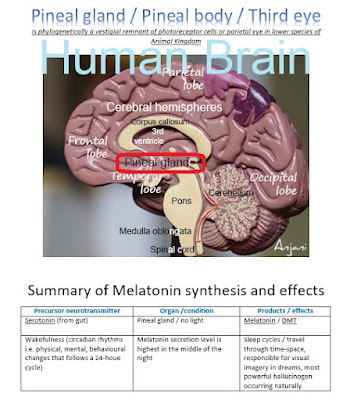
Pineal gland, the mystical third eye

Pineal gland   It is a very small unpaired midline brain structure of endocrine gland, tiny as a rice grain size, situated laterally (anatom...