Saturday, November 1, 2014

History of Chhattisgarh in a nutshell

Though a separate state of Chhattisgarh became reality, 

when it was declared the 26th state of India on 1st November 2000;

but the history of Chhattisgarh 
goes back to tens of thousands of years !!

Anthropological evidences
The anthropologists have found evidences of some of the earliest human habitations in the rocks and cave of this ancient land.
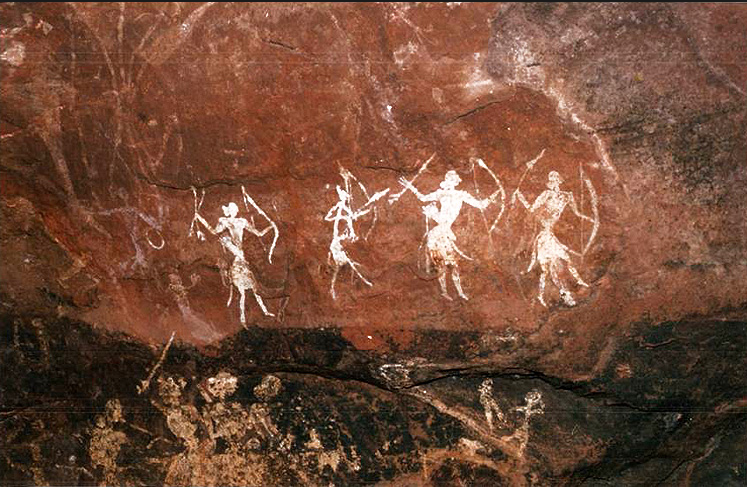
pic courtesy:http://www.bradshawfoundation.com/india/pachmarhi/
Hstorical evidence of rich human habitation starts from the 'Stone Age', as Singhanpur caves of Raigarh district and Kabra hill rock painting are about 30 to 50 thousands years old.
*http://www.cgculture.in/archaeology/Rock%20Art%20Site%20In%20Chhattisgarh.htm
*http://www.bradshawfoundation.com/india/pachmarhi/
*http://www.indiamike.com/india/chhattisgarh-f148/trip-report-to-singhanpur-caves-raigarh-t179119/
*http://wikimapia.org/13583821/Singhanpur-Caves 

Mythological history:
The mythological history of Chhattisgarh region stretches back to the period of Ramayana and Mahabharata. According to legends the deep Sal forest regions are Dandakaranya itself, where Lord Rama spent much of his fourteen-year exile from Ayodhya.

Ramgarh hill site where caves are caves and paintings are ound
bill board depicting possible route of Rama,s travel through these places

South Kosal or Maha Kosal was an old name of Chhattisgarh, which differentiated it from Kosal of north i.e. Ayodhya and Shrawasti. 
Bastar region of Chhattisgarh also named as Kantar or Mahakantar or Dandakaranya.

As per reference in Ramayana, Koshilya the mother of Rama was the daughter of King Bhanumant, who belonged to the family of a powerful king dynasty Kosal, south of Vindhyan mountain near Nagpattan. As Bhanumant had no sons, after marriage of his daughter to Ayodhya king Dashrath, this Kosal state was annexed to his state.

As Rama, Laxman and Sita spent much of their 14 year exile in Dandakaranya, there are many places related to their sojourn and stay. Ram devotee Bhil lady Shabri was born in Shivarinarayan.

Various places of Chhattisgarh have been referred in Mahabharat. 
States won by Sahdev named Prakkosal, Arany areas of Bastar were referredf as Kantar state. Places won by Karn is called Kosal janapad.

Chitrangada's father Chitravas was the king of Chitrangadpur (Sirpur). Vabhruvahan, son of Arjun and Chitrangada was the king of Chedi.
Temples at Rajim, called Triveni of Chhattisgarh
Ballabhachary birth place, Champaran near Rajim

Stone inscriptions (शिलालेख) from places on the banks of Mahanadi river; Sirpur, Rajim, Aarang states that Kings of this region called them self Pandav and regarded Vabhruvahan as their ancestor. It is believed that Chedidesh state of Vabhruvahan was later called Chedigarh and then on Chhattisgarh.
Ramgarh range of hills
Ramgarh hill
Cave painting in Ramgarh hill
Cave writing in Ramgarh hill
Drama stage at the cave site of Ramgarh hill

Caves of Ramgarh hills in Surguja have two stone inscriptions in Pali script of Buddha period. These two stone inscriptions of Sita Bengra and Jogimogra are believed to be of Ashoka period. 
This inscription refers to Sutanuka (a देवदासी) and her lover Devdeen. 
Sita Bengra cave have an amphitheatre of Buddha period.

Kotadola, a place west to Ambikapur, there is a Ashoka's three lion emblem inscribed on a stony structure, which supports the idea that Ashoka's kingdom was all up to this place

Like that in the north east of Kawardha, a Rishabhdev's beautiful statue believed to be of Mahavir period.
Jain Teerhankar idol found at Maheshpur
Unbroken history chain of Chhattisgarh
History of Chhattisgarh or South Kosala can be traced back only from the 4th century AD. Between the 6th and 12th centuries AD the Sarabhpurias, Panduvanshi, Somvanshi, Kalchuri, and Nagvanshi rulers dominated this region. 

The medieval period
This region came to be known as Gondwana and became the part of the kingdom of the Kalchuris who ruled the region till the end of the 18th century AD.
*http://throughpicture.blogspot.in/2012/10/culture-embeded-in-stone-maheshpur.html
*http://throughpicture.blogspot.in/2012/11/stony-emotions-from-maheshpur-india.html
Excavation site at Maheshpur
Vishnu and other idols found in Maheshpur
Shivling found in Maheshpur
Madwa Mahal temple at Kawardha (1349, Fadinagvanshi king Ramchandra)
Bhoramdev temple, Kawardha, called Khajuraho of Chhattisgarh, belongs 1349, Fadinagvanshi king Ramchandra


The Mughal period
The Muslim chroniclers of the 14th century AD have described well about the dynasties that ruled over the region. The region also came under the suzerainty of the Mughal Empire around the 16th century and later to the Marathas in 1745. By the year 1758, the whole region of Chhattisgarh was annexed by the Marathas. Also the word 'Chhattisgarh' was popularized during the Maratha period and was first used in an official document in 1795.

Colonial era
With the British entry in the early 19th century, much of the territory was subsumed into the Central Provinces. From 1854 onwards the British administered the region as a deputy commissionership with its headquarters at Raipur. 

#Chhattisgarh also took part in the 1857 Revolution when Vir Narayan Singh, a landlord of Sonakhan, grew up to challenge the injustices of British rule in the region. After a prolonged battle with the British forces, Vir Narain Singh was finally arrested and later hanged on the 10th December 1857. 

#In the year 1904 British reorganized the region and transferred Sambalpur to Orissa and added the estates of Surguja to Chhattisgarh.
*http://throughpicture.blogspot.in/2013/03/architecture-with-endemic-flavour.html
Emblem of Surguja state
Revenue stamp of Surguja state
Kothi Ghar, The Palace, traditiopnal seat of governance of Surguja state

T S Singhdeo, Maharaja of Surguja state, now MLA from Ambikapur
Note of thanks for share and citation courtesies:
*For the family tree of Ratanpur king Mayurdhwaj, refer to A.Cunningham, Archaeological Survey of India 

 https://archive.org/search.php?query=creator%3A%22Archaeological%20Survey%20of%20India%22
*Refer to Nelson and Dr. Heeralal for Bilaspur gazetteer for the family tree of Kalchuri kings of Ratanpur and Raipur branch
*some text references thankfully consulted from a book, Chhattisgarh (2003 edition) by Dr.Kaushlendra Tripathi and Dr.Purushottam Chandrakar
*some text reference thankfully shared from:http://www.tourismofchhattisgarh.com/tourism-of-chhattisgarh/history-of-chhattisgarh.html
*author extends thanks to Ms Padmavati Pandey for her valuable input and meaningful discussions during the preparation of this post.

Monday, October 20, 2014

River system in North Chhattisgarh of India linked to Indo-Gangetic plain

The major river (drainage) systems of India are:
1. Himalayan drainage system: Himalayan rivers originate in the Himalayas and flow through the Northern Plains.
2. Peninsular drainage system: The Peninsular Rivers originate in the Western Ghats. They have a large seasonal fluc­tuation in volume as they are solely fed from rain­fall.
Image Courtesy : gsabulletin.gsapubs.org/content/122/3-4/336/F1.large.jpg

*Major Indian rivers origin in Himalayan mountain and they flow either to Bay of Bengal or Arabian sea to drain their water flow into the sea.

*Big rivers of peninsular plateau origin in Western Ghats and they empty their water to the Bay of Bengal.

*Narmada and Tapi are two exceptions to this as they empty their water in Arabian sea.


*Interestingly Chambal, Betwa, Son are older to Himalayan rivers in origin and age.

The Himalayan Drainage system:
*In Miocene geological epoch (24,000,000 -500,000 years), a giant river Shiwalik or Indo-Brahma flowed parallel to Himalaya, from Assam to Punjab, discharging water in Sindh basin near Punjab.
http://www.mapsofindia.com/maps/india/drainage-river-basins.html

*Later this Indo-Brahma divided into three drainage systems;
1. Sindh and it's five tributaries in west
2. Ganga and it's tributaries in central
3. Brahmaputra and it's tributaries in east.

*This division of Indo-Brahma giant river was perhaps due to uplifting of western parts of Himalaya and Potwar plateau (Delhi ridge), in Pleistocene epoch.

*In similar way during Pleistocene epoch, in between Raj Mahal hills and Meghalaya plateau, change in Malda gap, diverted the Ganga and Brhamputra river systems which flowed to Bay of Bengal.
================================================================

Major rivers of Chhattisgarh:
The main rivers flowing through the state of Chhattisgarh are Mahanadi, Indravati, Godavari, Narmada and many others.
These rivers, with many other tributaries, local rivers, and streams drain the state.

Major river basin of Chhattisgarh:
1.The northern part of Chhattisgarh shares a part of the Indo-Gangetic plain.

2.The Satpura Range and the Chhota Nagpur Plateau divide the Mahanadi River basin from the Indo-Gangetic plain. This Mahanadi river basin basically forms the central part of the state.

3.The southern zone of Chhattisgarh includes a part of the Deccan plateau and is served by the Godavari river and its tributaries.
pic credit:http://upload.wikimedia.org/wikipedia/
Ganga river drainage basin:
The Rihand River (also referred to as Rend, Rer or Rehar) is a tributary of the Son River and flows through the Indian states of Chhattisgarh and Uttar Pradesh.

The Rihand rises from Matiranga hills, in the region south west of the Mainpat plateau, which is about 2,100 meters above mean sea level. The river flows north roughly through the central part of Surguja district for 160 kilometres (99 mi).  
#Rihand river has a fall named Rakashgand fall in its journey in Surguja district of Chhatishgarh.This fall is important for tourist point of view.

The Rihand and its tributaries form a fertile plain in the central part of the district stretching from around Ambikapur to Lakhanpur and Pratappur. Thereafter, it flows north into Sonbhadra district of Uttar Pradesh via Singrauli district of Madhya Pradesh, where it is called Rhed and finally joins the Son.

It's principal tributaries in Surguja district are the Mahan, the Morana (Morni), the Geur, the Gagar, the Gobri, the Piparkachar, the Ramdia and the Galphulla. Many seasonal and perennial rivers join the Rihand reservoir such as the Kanchan, the Mayar and the Azir of Singrauli district of Madhya Pradesh.
text source:http://en.wikipedia.org/wiki/Rihand_River 
*author extends thanks to Ms Padmavati Pandey for her valuable input and meaningful discussions during the preparation of this post. 

Wednesday, October 8, 2014

Super-resolved fluorescence microscopy

The optical microscope became a nanoscope
http://www.nobelprize.org/ site as the countdown begins for the announcement
 
photo source: Reuters

8 October 2014
The Royal Swedish Academy of Sciences
has decided to award the Nobel Prize in Chemistry for 2014 to
Eric Betzig
Janelia Farm Research Campus, Howard Hughes Medical Institute, Ashburn, VA, USA, Stefan W. HellMax Planck Institute for Biophysical Chemistry, Göttingen, and German Cancer Research Center, Heidelberg, Germany and
William E. Moerner
Stanford University, Stanford, CA, USA “for the development of super-resolved fluorescence microscopy” https://www.youtube.com/watch?v=aghy_pQYc2w#t=42

The Nobel Prize in Chemistry 2014 was awarded jointly to
Eric Betzig, Stefan W. Hell and William E. Moerner  
"for the development of super-resolved fluorescence microscopy".
Surpassing the limitations of the light microscope
For a long time optical microscopy was held back by a presumed limitation: that it would never obtain a better resolution than half the wavelength of light. Helped by fluorescent molecules the Nobel Laureates in Chemistry 2014 ingeniously circumvented this limitation. Their ground-breaking work has brought optical microscopy into the nanodimension.
They brought optical microscopy into the nanodimension
Eric Betzig, Stefan W. Hell and William E. Moerner are awarded the Nobel Prize in Chemistry 2014 for having bypassed a presumed scientific limitation stipulating that an optical microscope can never yield a resolution better than 0.2 micrometres.
source:http://www.nobelprize.org/

The new microscopy in chemistry
“Because we can see individual macromolecules moving about in a living cell, we can study chemistry at a single-molecule level and in real life. And this is very, very important to chemistry because chemistry has traditionally been about studying a large number of molecules and the effect that they have. Here we can look at a single molecule as it is active in a chemical system. That means that rare events can be studied in a very different way. Reactions can be studied as they happen, not as the end result but actually as they take place. It opens entirely new possibilities for chemistry and for biochemistry.”

(Sven Lidin, chair of the Nobel chemistry committee)

Eric Betzig
Born: 1960, Ann Arbor, MI, USA
Affiliation at the time of the award: Jannelia Farm Research Campus, Howard Hughes Medical Institute, Ashburn, VA, USA
Prize motivation: "for the development of super-resolved fluorescence microscopy"
Prize share: 1/3
Other resources: http://www.nobelprize.org/nobel_prizes/chemistry/laureates/2014/betzig-or.html

"Chemistry was always my weakest subject" New Chemistry Laureate Eric Betzig was in Germany preparing for a keynote when he got the call from Stockholm.


Stefan W. Hell
Born: 1962, Arad, Romania
Affiliation at the time of the award: Max Planck Institute for Biophysical Chemistry, Göttingen, Germany, German Cancer Research Center, Heidelberg, Germany
Prize motivation: "for the development of super-resolved fluorescence microscopy"
Prize share: 1/3
Other resources: http://www.nobelprize.org/nobel_prizes/chemistry/laureates/2014/hell-or.html

Stefan W. Hell: "I love to be a scientist." New Chemistry Laureate Stefan W. Hell was going through the details of a paper when he got the news that he had been awarded the 2014 Nobel Prize in Chemistry together with Eric Betzig and William E. Moerner. He then finished reading the paragraph - and then called his wife.


William E. Moerner
Born: 1953
Affiliation at the time of the award: Stanford University, Stanford, CA, USA
Prize motivation: "for the development of super-resolved fluorescence microscopy"
Prize share: 1/3
Other resources: http://www.nobelprize.org/nobel_prizes/chemistry/laureates/2014/moerner-or.html

William E. Moerner: "Your heart races. Can this be?" William E. Moerner was in Brazil to take part in a conference when the call came from Stockholm.  


Facts on the Nobel Prize in Chemistry 
105 Nobel Prizes in Chemistry have been awarded between 1901 and 2013. 63 Chemistry Prizes have been given to one Laureate only. 4 women have been awarded the Chemistry Prize so far. 1 person, Frederick Sanger, has been awarded the Chemistry Prize twice, in 1958 and in 1980. 35 years was the age of the youngest Chemistry Laureate ever, Frédéric Joliot, who was awarded the Nobel Prize in 1935. 85 years was the age of the oldest Chemistry Laureate, John B. Fenn, when he was awarded the Chemistry Prize in 2002. 58 is the average age of the Nobel Laureates in Chemistry the year they were awarded the prize.

New light to illuminate the world


Press Release
7 October 2014
has decided to award the Nobel Prize in Physics for 2014 
to
Isamu Akasaki
Meijo University, Nagoya, Japan and Nagoya University, Japan
Hiroshi Amano
Nagoya University, Japan
and
Shuji Nakamura
University of California, Santa Barbara, CA, USA

“for the invention of efficient blue light-emitting diodes which has enabled bright and energy-saving white light sources”
source:nobelprize.org
Blue LEDs - Filling the world with new light
This year’s Nobel Laureates are rewarded for having invented a new energy-efficient and environment-friendly light source – the blue light-emitting diode (LED). In the spirit of Alfred Nobel the Prize rewards an invention of greatest benefit to mankind; using blue LEDs, white light can be created in a new way. With the advent of LED lamps we now have more long-lasting and more efficient alternatives to older light sources.
http://www.nobelprize.org/nobel_prizes/physics/laureates/2014/press.html  
source:nobelprize.org
The Nobel Prize in Physics 2014 was awarded jointly to Isamu Akasaki, Hiroshi Amano and Shuji Nakamura "for the invention of efficient blue light-emitting diodes which has enabled bright and energy-saving white light sources".
https://www.youtube.com/watch?v=yul4igVhrMo
source:nobelprize.org

Announcement of the 2013 Nobel Prize in Physics by Professor Staffan Normark, Permanent Secretary of the Royal Swedish Academy of Sciences, on 7 October 2014. 
http://www.nobelprize.org/nobel_prizes/physics/laureates/2014/announcement.html


Isamu Akasaki
Born: 1929, Chiran, Japan
Affiliation at the time of the award: Meijo University, Nagoya, Japan, Nagoya University, Nagoya, Japan
Prize motivation: "for the invention of efficient blue light-emitting diodes which has enabled bright and energy-saving white light sources"
Prize share: 1/3
Other resources:http://en.nagoya-u.ac.jp/people/distinguished_award_recipients/nagoya_university_distinguished_professor_isamu_akasaki.html

Ill. N. Elmehed. © Nobel Media 2014


Hiroshi Amano
Born: 1960, Hamamatsu, Japan
Affiliation at the time of the award: Nagoya University, Nagoya, Japan
Prize motivation: "for the invention of efficient blue light-emitting diodes which has enabled bright and energy-saving white light sources"
Prize share: 1/3
Other resources:http://profs.provost.nagoya-u.ac.jp/view/html/100001778_en.html

Ill. N. Elmehed. © Nobel Media 2014


Shuji Nakamura
Born: 1954, Ikata, Japan
Affiliation at the time of the award: University of California, Santa Barbara, CA, USA
Prize motivation: "for the invention of efficient blue light-emitting diodes which has enabled bright and energy-saving white light sources"
Prize share: 1/3
Other resources:http://ssleec.ucsb.edu/

Interview transcript

"I was so happy. And I was so surprised!

"Shuji Nakamura was asleep in California when he got the call that he had been awarded the 2014 Nobel Prize in Physics together with Isamu Akasaki and Hiroshi Amano. But now there's "No time for sleep. No time for rest.". Hear how he reacted when he got the call from Stockholm. 

"Always there is a problem and I have to solve the problem." http://www.nobelprize.org/nobel_prizes/physics/laureates/2014/nakamura-telephone.html


Facts on the Nobel Prize in Physics
 

Tuesday, October 7, 2014

Grid cell system in hippocampus as brain's navigational place (inner GPS)

The Nobel Prize in Physiology or Medicine 2014
for
Grid cell system in hippocampus as brain's navigational place (inner GPS)

How do we know where we are? 
How can we find the way from one place to another? 
And how can we store this information in such a way 
that we can immediately find the way the next time we trace the same path? 
This year´s Nobel Laureates have discovered a positioning system, 
an “inner GPS” in the brain that makes it possible to orient ourselves in space, 
demonstrating a cellular basis for higher cognitive function.
source:nobelprize.org/
The Nobel Prize in Physiology or Medicine 2014 was divided, one half awarded to John O'Keefe, the other half jointly to May-Britt Moser and Edvard I. Moser  
"for their discoveries of cells that constitute a positioning system in the brain".


Announcement of the 2014 Nobel Prize in Physiology or Medicine by Professor Göran K. Hansson, Secretary of the Nobel Committee for Physiology or Medicine, on 6 October 2014.
See a Video of the Announcement
29 sec.
Credits: Ladda Productions AB (production)Copyright @ Nobel Media AB 2014


"I’m over the moon actually"


John O'Keefe

Born: 1939, New York, NY, USA

Affiliation at the time of the award: University College, London, United Kingdom

Prize motivation: "for their discoveries of cells that constitute a positioning system in the brain"

Field: physiology, spatial behavior

Prize share: 1/2
Transcript of the interview with John O'Keefe 
"I thought 'Oh this couldn't possibly be, this couldn't possibly be what I think it is.' But of course it was."
http://www.nobelprize.org/nobel_prizes/medicine/laureates/2014/okeefe-telephone.html
Photo: David Bishop, UCL


"This is so great"
May-Britt Moser
Born: 1963, Fosnavåg, Norway
Affiliation at the time of the award: Centre for Neural Computation, Trondheim, Norway
Prize motivation: "for their discoveries of cells that constitute a positioning system in the brain"
Field: physiology, spatial behavior
Prize share: 1/4 
Transcript of the interview withMay-Britt Moser 
"It's easy for us because we can have breakfast meetings almost every day”
http://www.nobelprize.org/nobel_prizes/medicine/laureates/2014/may-britt-moser-telephone.html
Photo: G. Mogen/NTNU


"I didn't understand anything"

Edvard I. Moser
Born: 1962, Ålesund, Norway
Affiliation at the time of the award: Kavli Institute for Systems Neuroscience, Trondheim, Norway
Prize motivation: "for their discoveries of cells that constitute a positioning system in the brain"
Field: physiology, spatial behavior
Prize share: 1/4
Transcript of the interview with Edward Moser
"I came out of the plane ... and then there was a representative of the airport who came with flowers and picked me up in a car."
http://www.nobelprize.org/nobel_prizes/medicine/laureates/2014/edvard-moser-telephone.html
Photo: G. Mogen/NTNU
Edward I. Moser - photo Gallery:


The discoveries of John O´Keefe, May-Britt Moser and Edvard Moser have solved a problem that has occupied philosophers and scientists for centuries – how does the brain create a map of the space surrounding us and how can we navigate our way through a complex environment?


A place for maps in the human brain
Recent investigations with brain imaging techniques, as well as studies of patients undergoing neurosurgery, have provided evidence that place and grid cells exist also in humans. In patients with Alzheimer´s disease, the hippocampus and entorhinal cortex are frequently affected at an early stage, and these individuals often lose their way and cannot recognize the environment. Knowledge about the brain´s positioning system may, therefore, help us understand the mechanism underpinning the devastating spatial memory loss that affects people with this disease.
http://www.nobelprize.org/nobel_prizes/medicine/laureates/2014/press.html 

Facts on the Nobel Prize in Physiology or Medicine

Monday, September 29, 2014

Exploring ecotourism in Chhattisgarh of India

Chhattisgarh state of India has emerged from ocean floor
==========================================
pic credit: AFP
a new island appeared on a Pakistani coastal town of Gwadar
Geologist believe that Chhattisgarh state of India was part of the ocean floor some 280,000,000 years ago. 

Earhquake and some other geological disturbances must have raised this portion up creating this land mass (report appeared in Bhaskar/13th October 2013 Sunday/pp3), just like in September 2013 a new island has emerged near Pakistan. Seismic activity appears to have sparked this unusual land formation, (http://www.bbc.com/news/world-asia-24272552).


Sonhat block of Koriya district in Chhattisgarh state of India does have remains which could easily be seen, fossilized molluscs (Seepi) are so abundantly scattered. Geological Survey of India has marked this region for the Ecotourism, which belongs to period between Eocene to Pliocene epoch.

These fossils date back to millions of years, are scattered in between Hasdeo river and Halia Nala, almost in one kilometer of area.

bhaskar/13t october 2013

This is the reason that plains of Raipur (state capital) is full of Lime stones below it's earth crust; declared reserved area by Geological Survey of India, naming it 'Marine Gondwana Fossils'.

Geological structure of Chhattisgarh state of India varies from most ancient to most recent rock types, which contains vivid mineral deposits in abundance.

*author extends thanks to Ms Padmavati Pandey for her valuable input and meaningful discussions during the preparation of this post.
#Globally seismic monitor link in real time:
http://www.iris.edu/hq/sis/data/seismon
#Globally lightning monitor site in real time:
http://www.lightningmaps.org/realtime

#Sun movement and sunlight phases during the given day at the given location.
suncalc.net

Thursday, September 25, 2014

Indian geological history based on rock types

Himalayan range emerged from the Tethys ocean
Alps, Carpathian in Europe, Hindukush in Afganistan to the west of Himalaya 
and mountains of Burma in the east,----millions of years ago it all were part of a great ocean Tethys. 

The Sea floor of the Tethys ocean was raised up by the collision to for the Himalayas. That is why you can find sea shell fossils on the top of Mount Everest! This is a destructive plate margin.

Continent to north to Tethys was Northern Pangea (Laurasia/Angaraland) 
and continent to south was Southern Pangea (Gondwanaland).

Various geological factors caused Tethys ocean to come up above the water level. 
This water scattered in the lower part of Gondwanaland. 
Gondwanaland looked fragmented in parts 
and so Indian Ocean came in existence.

At one time, the Indian craton was a segment of the Pangaea supercontinent. During that period, it was linked with Southern Africa and Madagascar on the southwestern shore and Australia beside the eastern shore. During the Jurassic era, at approximately 160 Ma (ICS 2004), fissuring led Pangaea to split into two supercontinents i.e. Laurasia (in the north) and Gondwana (in the south). However, the Indian craton stayed linked to Gondwana till the supercontinent started to split into pieces approximately in the beginning phase of the Cretaceous era around 125 Ma (ICS 2004). The tectonic plate of India started moving to the north in the direction of the Eurasian plate. This geological process, which is going on at present, is associated with the sealing of the Tethys Ocean. The Tethys Ocean’s sealing had resulted in formation of the Caucasian Mountain Range in West Asia and the Alps in Europe. It also formed the Tibetan highland in South Asia and the Himalayan Mountain Ranges.
pic courtesy: http://science.taskermilward.org.uk/mod1/KS4Chemistry/AQA/Module2/10_2_15.htm
#reference for classification of Indian rocks:http://www.thecsatupsc.com/2013/04/classification-of-indian-rocks.html


Geological history of India based on rock types
The Geological History of India began with the geographical transformation of other parts of the earth, to be precise, 4.57 Ga (billion years back). 
India is famous for its varied geological features. 
Various parts of India are made up of rocks of all categories of several geologic periods. 
A few of the rocks are poorly malformed and metamorphosed. 
At the same time, other types of rocks are newly silted alluvial soils that are still to go through chemical and physical changes. 
Source of minerals of significant diversity is seen in the subcontinent area in substantial amount.(text courtesy:http://www.mapsofindia.com/500-things-to-know-about-india/geological-history-of-india/)


Map of chronostratigraphic divisions of India
There are three types of rocks: igneous, metamorphic, and sedimentary. The first two are formed under conditions of extreme heat and pressure.
Igneous rocks are formed when magma cools into solid form. This can happen on the surface with volcanic discharge, but primarily takes place beneath the earth’s crust. A majority — about 90% — of igneous rocks are silicate minerals, which are rich in silicon and oxygen. Quartz is among the most familiar and abundant of this type; clays and feldspar are other examples.
 Metamorphic rocks are formed when a preexisting rock, called a protolith, is under conditions of high heat and pressure, causing it to metamorphose chemically, structurally, or both. The protolith might be an igneous, sedimentary, or another metamorphic rock. Slate, marble, and quartzite are some examples of this type.

Sedimentary rocks are less abundant than the other two varieties, composing only 5% or so of the earth’s crust. This type of rock is formed over long periods of time as tiny grains of material are pressed against each other and join loosely. The process by which sedimentary rocks are formed is delicate enough that fossils can be preserved within them. Common examples include sandstone, chalk, and limestone.
picture credit:http://en.wikipedia.org
text credit:http://www.wisegeek.org/what-are-the-different-types-of-rocks.htm


Geology and major structures of Himalayas
picture credit:http://www.geo.arizona.edu/geo5xx/geo527/Himalayas/geology.html
Three clear regions of India based on rock types
The geological history of India, it ranges from most archaic to most newly formed rock types.

As rocks date back to Pre Archaen and Pre Cambrian period, their age could well be compared with the age of India itself. 

The latest rocks of Quarternary period are found in alluvial deposits (in the form of layer after layer deposits).

The three divisions based on rock types are as follows:

1. A substantial territory of peninsular India, which is also known as the Indian Shield, comprises schists and Archean gneisses and these are the earliest forms of rocks seen in India. These are 'original' rocks, made by cooling of the Earth from molten phase. This is part of the Gondwanaland.

2. Rocks of Himalayan mountain and newly formed other moulded related mountain range which are formed later to the rocks of peninsular India, is called Tertiary rocks. Such rocks were formed of the deposits from the base of the ocean.

3.  Indo-Gangetic basin , which were formed later to Himalayan mountain range, are Quarternary rocks formed by the alluvial deposits of alluvial soil. This soil is worn down from the Himalayas by rivers originating from Himalayan mountain range.

Above three physical regions of India  were formed gradually one after other.

Rock type reserve
Archaic Archean rocks are best for Iron and Gold reserve while rocks of Carboniferous period are known for Coal reserve. 
There are more chances of finding mineral oil in rocks formed by the precipitates of ocean. 

Himalayan rivers are older than Himalayas
There are two major river systems in India based on the origin:

1.Himalayan Rivers: These rivers are again subdi­vided into two groups. Trans Himalayan and Hima­layan. The Trans-Himalayan Rivers originate beyond the Great Himalayas. These are the Indus, the Sutlej and the Brahmaputra rivers. Himalayan rivers are those which originate in the Himalayas and flow through the Northern Plains, e.g., the Ganga, the Yamuna and their tributaries. These rivers are useful for irrigation and navigation and the lowlands drained by them have fertile alluvial deposits. 

The main Himalayan river systems are the Ganga, the Indus and the Brahmaputra river systems. The Himalayan rivers form large basins. Many rivers pass through the Himalayas. These deep valleys with steep rock sides were formed by the down - cutting of the river during the period of the Himalayan uplift. They perform intense erosional activity up the streams and carry huge load of sand and silt. In the plains, they form large meanders, and a variety of depositional features like flood plains, river cliffs and levees.

These rivers are perennial as they get water from the rainfall as well as the melting of ice. Nearly all of them create huge plains and are navigable over long distances of their course. These rivers are also harnessed in their upstream catchment area to generate hydroelectricity.

2.Peninsular rivers: The main peninsular river systems include the Narmada, the Tapti, the Godavari, the Krishna, the Kaveri and the Mahanadi river systems. The Peninsular rivers flow through shallow valleys. A large number of them are seasonal as their flow is dependent on rainfall. The intensity of erosional activities is also comparatively low because of the gentler slope. The hard rock bed and lack of silt and sand does not allow any significant meandering. Many rivers therefore have straight and linear courses. These rivers provide huge opportunities for hydro-electric power.
Image Courtesy : gsabulletin.gsapubs.org/content/122/3-4/336/F1.large.jpg
Pic courtesy: http://www.mapsofindia.com/maps/india/geographical.htm
source: www.wikimedia.org
*author extends thanks to Ms Padmavati Pandey for her valuable input and meaningful discussions during the preparation of this post.
#Find out where an earthquake has occurred today !!
http://www.iris.edu/hq/sis/data/seismon 

#reference for Indian rivers in nutshell: http://www.winentrance.com/general_knowledge/geography/rivers.html

Brain waves

Brain waves   Brain cells communicate both sensory and motor impulses with the help of electrical current in all states of life i.e. resting...