Saturday, November 10, 2012

Equation Of Time

amateur  astronomy series #3

The Analemma of Time
 The equation of time (The word "equation" is here used in a somewhat archaic sense, meaning "correction". Prior to the mid-17th Century, when pendulum-controlled mechanical clocks were invented, sundials were the only reliable timepieces, and were generally considered to tell the right time.) is the difference between apparent solar time and mean solar time. At any given instant, this difference will be the same for every observer on Earth.
 Apparent (or true) solar time can be obtained for example by measurement of the current position (hour angle) of the Sun, or indicated (with limited accuracy) by a sundial. Mean solar time, for the same place, would be the time indicated by a steady clock set so that over the year its differences from apparent solar time average to zero (with zero net gain or loss over the year).
The equation of time is also the east or west component of the analemma, a curve representing the angular offset of the Sun from its mean position on the celestial sphere as viewed from Earth. The equation of time values for each day of the year, compiled by astronomical observatories, were widely listed in almanacs and ephemerides.
as in Northern hemisphere
 The equation of time commonly is represented in diagramatic form as an anlemma of time showing both solar declination and the difference between true and mean solar time over the course of a year. The diagram portrays the approximate equivalence of true solar with mean solar time in mid-April, mid-June, the end of August and late December. Solar time leads by around 2 minutes at the December Solstice, 4 minutes in mid May , 7.5 at the September Equinox and 16 minutes in early November. It lags by around a minute at the June Solstice, 7.5 minutes at the March Equinox, 6 at the end of July and 14 minutes in mid February.

Equinox (equal night)
Two instances each year at which the Sun appears to cross the celestial equator. The spring or Vernal Equinox occurs around March 21, when the sun is overhead at the Earth's equator, crossing from south to north. The Autumnal Equinox occurs when it crosses from north to south, around September 23. At the time of equinoxes, day and night are of equal length all over the world, the sun rising due east and setting due west on those days.
The Earth in its orbit around the Sun causes the Sun to appear on the celestial sphere moving over the ecliptic (red), which is tilted on the Equator (white).


Solstice: word solstice is derived from the Latin sol (sun) and sistere (to stand still)
The time when Sun is at it's greatest declination, 23.5 N or 23.5 S, marking the northern ( northern solstice) and southern limits of it's annual path along the ecliptic. In the Northern Hemisphere the summer solstice occurs around June 21, when the sun reaches it's highest altitude in the sky and is overhead at the  Tropic of Cancer  ( Cancer). This marks the longest day of the year, the period of maximum daylight. The winter solstice occurs around December 22, when the sun reaches it's lowest altitude, being overhead at the  Tropic of Capricorn (Capricorn). This is the point of the shortest day, when daylight hours are at a minimum. The solstices are reversed in the Southern Hemisphere 
 The Latin names Hibernal solstice (winter) and Aestival solstice (summer) are sometimes used.
Illumination of Earth by Sun at the northern solstice.
Illumination of Earth by Sun at the southern solstice.

*Note: all pictures thankfully shared from various sources..


Thursday, November 8, 2012

Global Warming: Climate Change And Green Policy

Global warming   
Since the early 20th century, Earth's mean surface temperature has increased by about 0.8 °C (1.4 °F), with about two-thirds of the increase occurring since 1980. Warming of the climate system is unequivocal, and scientists are more than 90% certain that it is primarily caused by increasing concentrations of greenhouse gases produced by human activities such as the burning of fossil fuels and deforestation.These findings are recognized by the national science academies of all major industrialized nations.
Global mean land-ocean temperature change from 1880–2011, relative to the 1951–1980 mean. The black line is the annual mean and the red line is the 5-year running mean. The green bars show uncertainty estimates. Source: NASA GISS


Observed and expected effects on life 
Over the past 100 years, the global average temperature has increased and projected to continue to rise at a rapid rate. Although species have responded to climatic changes throughout their evolutionary history, a primary concern for wild species and their ecosystems is this rapid rate of change. The gathered information on species and global warming from studies reveal a consistent temperature-related shift, or 'fingerprint', in species ranging from molluscs to mammals and from grasses to trees. Indeed, more than 80% of the species that show changes are shifting in the direction expected on the basis of known physiological constraints of species. Consequently, the balance of evidence from these studies strongly suggests that a significant impact of global warming is already discernible in animal and plant populations. The synergism of rapid temperature rise and other stresses, in particular habitat destruction, could easily disrupt the connectedness among species and lead to a reformulation of species communities, reflecting differential changes in species, and to numerous extirpations and possibly extinctions.
The increase in ocean heat content is much larger than any other store of energy in the Earth’s heat balance over the two periods 1961 to 2003 and 1993 to 2003, and accounts for more than 90% of the possible increase in heat content of the Earth system during these periods.


Observed and expected effects on environment Greenhouse gas, Greenhouse effect, Radiative forcing, and Carbon dioxide in Earth's atmosphere
This graph, known as the Keeling Curve, shows the increase of atmospheric carbon dioxide (CO2) concentrations from 1958–2008. Monthly CO2 measurements display seasonal oscillations in an upward trend; each year's maximum occurs during the Northern Hemisphere's late spring, and declines during its growing season as plants remove some atmospheric CO2.
The 20th century instrumental temperature record shows a sudden rise in global temperatures.

These temperatures are expected to excaberate the hydrological cycle, with more intense droughts and floods.The effect on hurricane activity is less certain. 

Changing monsoon pattern
In the coming time, the consequence of  global warming is going to be severe as monsoon will be delayed after every five years. The prediction of the changing monsoon pattern has been done by Professor Anders Levermann at Climate Impact Research.

Anders Levermann said, "In the past century the Indian monsoon has been very stable. It is already a catastrophe with 10% less rain than the average".


picture source: the hindu.com
The Indian monsoon on which more than a billion people depend for food crops - could fail frequently and catastrophically over the next 200 years as a result of global warming. The researchers define monsoon failure as a drop of between 40 and 70 percent in rainfall, compared with normal levels - something that's never happened in the 140 years of measurements by the India Meteorological Department.

But by 2150, says the Potsdam Institute for Climate Impact Research and Potsdam University team, the rains could be failing every fifth year. India's economy relies heavily on the monsoon season to bring fresh water to farmlands.

"Our study points to the possibility of even more severe changes to monsoon rainfall caused by climatic shifts that may take place later this century and beyond," says lead author Jacob Schewe.
The changes, say the team, would be triggered by increasing temperatures and a change in strength of the Pacific Walker circulation in spring.

The Walker circulation usually brings areas of high pressure to the western Indian Ocean. However, in years when El Niño occurs, this pattern gets shifted eastward, bringing high pressure over India and suppressing the monsoon, especially as it begins to develop in spring.

But the researchers' simulations showed that as temperatures increase in the future, the Walker circulation will bring more high pressure over India - even if El Niño doesn't occur any more often.
*The findings may be controversial, as most models conclude that global warming is more likely to increase monsoon rainfall, rather than decrease it.
  
Do we need a common global strategy !!
About 200 nations have joined hands in reducing the impact of global warming so that natural disasters like draught and flood could be avoided. From 26th of November onwards environment ministries from all over the world will attend a meeting in Qatar. The meeting will be aimed at reducing the global warming impacts.


Climate deal !!
Protecting the world so future generations can enjoy the same benefits requires their rights 
to be expressed now.
Barack Obama speaks at the climate summit in Copenhagen in December 2009. Photograph: Anja Niedringhaus/AP
What does a second term for Barack Obama as US president mean for action on climate change..
The good omens. Climate change was cited in his victory speech, albeit among 2000 other words: "We want our children to live in an America that isn't burdened by debt, that isn't weakened by inequality, that isn't threatened by the destructive power of a warming planet."
  It is a clear advantage to have a president who understands the threat climate change leading the world's biggest historical polluter in the make-or-break year of 2015.
NASA satellite picture of Superstorm Sandy's path of destruction along U.S. East Coast.

Perhaps, chillingly, it will take more searing heatwaves and superstorms to strike to prompt Obama into serious action. But low odds are better than no odds, and that's what a President Romney would have meant (Mitt Romney, whose statement that the president's job was not to stop the sea rising was hideously exposed by the inundation of New York and New Jersey by the surge of superstorm Sandy).

A grim reminder:
Al Gore, Nobel prize acceptance speech, 2007
 We, the human species, are confronting a planetary emergency – a threat to the survival of our civilization that is gathering ominous and destructive potential even as we gather here. But there is hopeful news as well: we have the ability to solve this crisis and avoid the worst – though not all – of its consequences, if we act boldly, decisively and quickly.
Al Gore delivering his Nobel Lecture in the Oslo City Hall, 10 December 2007.
Copyright © The Norwegian Nobel Institute 2007
Photo: Ken Opprann
UNO forum expresses concern over:

United Nations: Secretary-General Ban Ki-moon said that one of the main lessons from Superstorm Sandy is the need for global action to deal with future climate shocks.

Ban told the UN General Assembly that it is difficult to attribute any single storm, like Sandy, to climate change.

 
"But we all know this: extreme weather due to climate change the new normal," he said. "This may be an uncomfortable truth but it is one we ignore at our peril."

With a new round of global climate talks set to begin on November 27 in Doha, Qatar, the UN chief urged the world's nations to reach a legally binding agreement by 2015 to rein in the emissions of heat-trapping gases in order to stop the planet from overheating.
It is the first time a Gulf state has hosted global climate negotiations

*Note: all pictures thankfully shared from various sources..


Monday, November 5, 2012

Astronomical Bodies: Moon Phases

amateur  astronomy series #2

Some astronomical bodies:

Milky Way (our galaxy)
Rotational velocity near the Sun 250 km/sec.
Rotational period near the Sun 225 million years.

Earth (our  Planet)A planet (from Ancient Greek αστήρ πλανήτης (astēr planētēs), meaning "wandering star") is a celestial body orbiting a star or stellar remnant that is massive enough to be rounded by its own gravity,
Spin on axis 23h 56m 4.091s
Orbits  Sun in 365days 5hours 48minutes 45.51seconds
Equatorial rotational velocity .5 km/sec
Escape velocity 11.2 km/sec

Nebula: Celestial objects that are clouds of gas and dust and so can not be resolve into stars. They emit their light in a series of emission lines.

Ursa Minor (Constellation)
The yellow dashed lines are constellation boundaries, the red dashed line is the ecliptic, and the shades of blue show Milky Way areas of different brightness. The map contains all Messier objects, except for colliding ones. The underlying database contains all stars brighter than 6.5. All coordinates refer to equinox 2000.0.
The map is calculated with the equidistant azimuthal projection (the zenith being in the center of the image). The north pole is to the top. The (horizontal) lines of equal declination are drawn for 0°, ±10°, ±20° etc. The lines of equal right ascension are drawn for all 24 hours. Towards the rim there is a very slight magnification (and distortion).

distances from our earth is;
Polaris (431.42 light years),
Yildun (182.72 lght years),
E Umi (346.61 light years),
T Umi (375.76 light years),
Kocab (126.47 light years),
Pherkad (480.35 light years),
n Umi (97.30 light years).

Polaris facts;
14,000 years time.
47° away from celestial pole
(1°=3600 seconds of arc)


Aries:
(Mesarthim, Sheratan, Hamal, Mu, Ari).
is the first astrological sign in the Zodiac. It spans the 0-30th degree of the zodiac, between zero and 27.25 degree of celestial longitude, which the Sun transits this area on average between March 21 to April 19 each year.

Moon Phases (Moon as seen by an observer, usually on  Earth):

*new moon (Full in shadow),
*Waxing Crescent (Less than half is illuminated),
*First Quarter (Approximately half is illuminated),

*Waxing Gibbons (More than half is illuminated),
*full moon (Whole moon illuminated),
*Waning Gibbons (More than half is illuminated),
*Last Quarter (Appoximately half is illuminated),
*Waning Crescent ( Less than half is illuminated and this gets less each night).
*Note: all pictures thankfully shared from various sources..
geographic coordinate system

latitude (http://en.wikipedia.org/wiki/Latitude): (abbreviation: Lat., φ, or phi)
positive value represent North of the equator 
negative value represent South of the equator 

positive value represent East of the Greenwitch Meridian
negative value represent West of the Greenwitch Meridian

# A sum up to follow for details if required:

Solar System Extrasolar objects
Simple objects Compound objects Extended objects

Thursday, November 1, 2012

Telescope: Pale Blue Dot

amateur  astronomy series # 1

Peering in to past through Hubble Telescope
....watching time itself !!
 **
The Hubble Space Telescope (HSTis a space telescope that was carried into orbit by a Space Shuttle in 1990 and remains in operation. A 2.4-meter (7.9 ft) aperture telescope in low Earth orbit, Hubble's four main instruments observe in the near ultraviolet, visible, and near infrared. The telescope is named after the astronomer Edwin Hubble.
(our only orbiting eye in space)
****

It came up with  a picture of 10,000 galaxies. The farthest galaxies seen in the frame are almost 13 billion light-years away.
The universe itself is said to be roughly 13-14 billion years old. So, as you look at the picture you are actually peering in to a very very distant past - a time when time itself had just begun ticking and the observable Universe had just taken shape.

Carl Sagan - "We live in an obscure corner of a remote galaxy (Milky Way)."
Earth is situated many million light-years away from the center of the universe that envelops us.


Almost everyone has seen the image (photograph) known as the Blue Marble, which was one of the first images taken of  Earth from outer space. A lesser known picture is the Pale Blue Dot. Voyager 1, the man-made object that has ventured most into space, turned around to look back just as it was leaving the outer limits of the  Solar System ( Family Portrait series of images).
This was because  Carl Sagan, the sci-fi author of Contact, asked  NASA to photograph the planet from 3.7 billion miles away. The purpose of this exercise was to show mankind's humble place in the universe, and the resulting photograph had a small blue dot (Pale Blue Dot) basking in the rays of the sun. Technically it was half a dot as the planet was so small from so far away that it registered only half a pixel (0.12 pixel) on Voyager 1's sensor.

*Note: all pictures thankfully shared from various sources..


Thursday, October 18, 2012

Wave Studio Tips

*sound science series # 7


Recording a new audio file !!
(RAW, WMA or WAV data file)
Sample rate (frequency): 
(frequency may be chosen from 8000 Hz to 96000 Hz)
# 11025 Hz suitable for voice recording,
# 22050 Hz suitable for tape quality recording, 
# 44100 Hz suitable for CD quality recording.

Sampling size:
8 bit     cassette tape quality (lower sound quality),
16 bit   CD quality,
24 bit   higher sound quality.


Channel 
Mono/Stereo options
* a Wave file with better sound quality requires a larger storage space because of it's higher sampling rate and size.


Mixing:
When mixing 8 bit data with 16 bit wave data, convert attributes via status bar.


Recording a new audio file:
Menu > File > New
Select: sampling rate, bit depth, recording device, playback device.
Menu > Audio > Record
File > Save
Enter the new file name and then click Save button


Using Direct X audio plug ins:
are software components that let you apply special effects to your audio files. You must install the plug-ins on your computer before you can use this feature.

Audio clean-up:
Menu> Audio Clean-up
Hiss removal 30 %
Click removal
Original Hiss level


Reverse:
Menu > Task > Reverse > Channels (select) > OK
*tips: unusual sound effects, if you mix a wave with it's reversed form.


Normalize:
Menu > Task > Normalize

Echo:
Task > Echo > Add Echo ( Echo Magnitude and Echo Delay) > OK

Fade-in and fade-out:
fading in (soft to loud)

fading out (loud to soft)
*effect to your entire audio file.


Invert Waveform:
Task > Invert Waveform > (select channels) > OK
This specific effect inverts the Waveform along it's horizontal axis.
*tips: you can create an unusual effect if you invert only one channel of a Stereo file.


Pan Left-to-Right or Pan Right-to-Left:
this effect applies to the Stereo files only.
*tips: This feature is useful if you want to simulate movement of a sound source from one end of the sound stage to the other.

Phase shift:
*tips: You can convert a Mono audio file to a Stereo audio file and apply this phase shift-effect. This will give the converted Mono file a 'pseudo-stereo effect'.


Volume:
Task > Volume
magnitude greater than 100 %, increase the Volume.
magnitude less than 100 %, decrease the Volume.
(Stereo = effects both the channels).

Adding markers:
on the Time > Ruler

right click the location, add Marker

or

Removal of markers 
Menu > Edit > Markers > Drop markers


Monitoring Volume:
peak indicator - how loud sound is 
valley indicator - how soft it is
five scales representing different volume range
( - 90 db to Infinity, - 24 db to Infinity etc.)
Options > Volume Meter
- 90 db to infinity,
- 78 db to infinity,
- 60 db to infinity,
- 42 db to infinity,
- 24 db to infinity.

Specifying Indicators:
Right click on the volume meter, lists all the indicators.

Changing Audio Set Up:
Menu > Options > Preferences > Audio: select your required audio devices for both Recording device and Play back device,
click OK.

Changing Editing options (undo operations):
Options > Preferences > Editing tab.


Monday, October 15, 2012

Acoustic Resonance

*sound science series # 6
Natural Frequency: The frequency at which an object vibrates when allowed to do so freely.
All objects vibrate when they are disturbed. When each object vibrates, it tends to vibrate at a particular frequency or set of frequencies. We call these frequencies an object's natural frequencies.
Example: a tuning fork will vibrate at only one frequency while a clarinet will vibrate at a set of frequencies.

Acoustic Resonance: Resonance involving sound waves
When objects or air particles vibrate, if the amplitude of the vibrations is large enough and if the frequency of the vibration is within the human hearing range, then the object will produce sound waves which are audible.
Example of acoustic resonance in air columns closed at one end;
*Our own voice (the vocal tract acts as an air column closed at one end with the open end near the lips.
*Music produced by blowing into plastic bottles filled with water.
*Music produced by a clarinet.
Resonance: The transfer of energy of vibration from one object to another having the same natural frequency.
Vibration: Repeated pattern of motion, also called a cycle.

Some musical instruments based on resonance phenomenon:
 instruments with vibrating strings (which would include guitar strings, violin strings, and piano strings), open-end air column instruments (which would include the brass instruments such as the trombone and woodwinds such as the flute and the recorder), and closed-end air column instruments (which would include some organ pipe and the bottles of a pop bottle orchestra). A fourth category - vibrating mechanical systems (which includes all the percussion instruments). These instrument categories may be unusual to some; they are based upon the commonalities among their standing wave patterns and the mathematical relationships between the frequencies that the instruments produce.
 If the frequency of the external force is equal to the natural frequency of the body (or to it's integral multiple), then the amplitude of the forced vibrations (or oscillations) of the body becomes quite large. This phenomenon is called resonance.
Thus, resonance is particular case of forced vibrations (or oscillations).
Examples:
a. Mechanical reonance.
   i. army passing over a bridge.
   b. sound resonance.
   i. resonance box
   ii. vibration of strings
   iii. dtermination of frequency
   iv. pouring of water in a vessel
   v. vibration of surrounding
   vi. resonator
b. Electromagnetic resonance
   i. radio

The Dark Side of Resonance,  
The Tacoma-Narrows Bridge 
Every powerful phenomenon in nature has its dark side and resonance is no exception. It's best experienced in moderation. Taken to an extreme, resonance causes things to break catastrophically. For example, when an opera singer with a very loud voice hits the right frequency she can cause a champagne glass to resonate and break. 
On the morning of November 7, 1940, the four month old Tacoma Narrows Bridge began to oscillate dangerously up and down. A reporter drove out on the bridge with his cocker spaniel in the car. The bridge was heaving so violently that he had to abandon his car and crawl back to safety on his hands and knees.
At about 11:00 the bridge tore itself apart and collapsed. It had been designed for winds of 120 mph and yet a wind of only 42 mph caused it to collapse. How could this happen? No one knows exactly why. However, the experts do agree that somehow the wind caused the bridge to resonate. It was a shocking calamity although the only loss of life was the cocker spaniel.
example of the forced vibration: say if the natural frequency of a glass cup is 497.955 Hz. Producing the same frequency from a guitar, vibrations (resonance), glass cup can be broken. So this 497.955 Hz is a 'Critical Frequency' of the glass bowl here in this example.


                                       Nikola Tesla (1856 - 1943) - Master of Resonanc

Nikola Tesla - Master of Resonance: Tesla was a genius who was obsessed with resonance. No discussion of resonance could be complete with out talking about Tesla.
 It was an innocent experiment. Tesla had attached a small vibrator to an iron column in his New York City laboratory and started it vibrating. At certain frequencies specific pieces of equipment in the room would jiggle. Change the frequency and the jiggle would move to another part of the room. Unfortunately, he hadn't accounted for the fact that the column ran downward into the foundation beneath the building. His vibrations were being transmitted all over Manhattan.
 
Sharp and flat resonance: Sharpness of resonance is, in a way, a measure of the rate of  fall of amplitude from it's maximum value at resonant frequency, on either side of it. The sharper the fall in amplitude, the sharper the resonance.
 Law of conservation of energy: In the case of a falling object, initial potential energy transformed into other forms of energy, i.e. into heat or sound
(or in other word, when sound is absorbed, it turns into heat).
 *Note: all pictures thankfully shared from various sources.

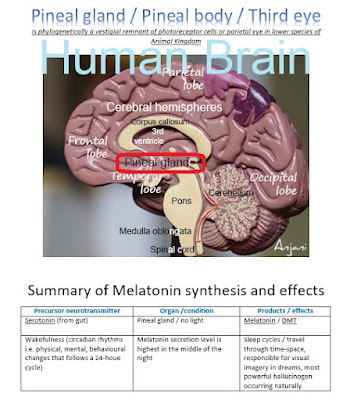
Pineal gland, the mystical third eye

Pineal gland   It is a very small unpaired midline brain structure of endocrine gland, tiny as a rice grain size, situated laterally (anatom...