Saturday, September 1, 2012

Indian Tectonic Plate: Rich Civilizational Cradle

Pangaea: was a supercontinent that existed during the late Paleozoic and early Mesozoic eras, forming about 300 million years ago and beginning to rift around 200 million years ago, before the component continents were separated into their current configurations. The single global ocean which surrounded Pangaea is accordingly named Panthalassa.

Plate Tectonics: is a scientific theory that describes the large-scale motions of Earth's lithosphere. The theory builds on the concepts of continental drift, developed during the first decades of the 20th century. It was accepted by the geoscientific community after the concepts of seafloor spreading were developed in the late 1950s and early 1960s.
 The lithosphere is broken up into tectonic plates. On Earth, there are seven or eight major plates (depending on how they are defined) and many minor plates. Where plates meet, their relative motion determines the type of boundary: convergent, divergent, or transform. Earthquakes, volcanic activity, mountain-building, and oceanic trench formation occur along these plate boundaries. The lateral relative movement of the plates typically varies from zero to 100 mm annually.
Indian Plate: is a tectonic plate that was originally a part of the ancient continent of Gondwana from which it split off, eventually becoming a major plate. About 55 to 50 million years ago (contested), it fused with the adjacent Australian Plate. It is today part of the major Indo-Australian Plate, and includes most of South Asia and a portion of the basin under the Indian Ocean, including parts of South China and Eastern Indonesia, and extending up to but not including Ladakh, Kohistan and Balochistan.

In the late Cretaceous about 90 million years ago, subsequent to the splitting off from Gondwana of conjoined Madagascar and India, the Indian Plate split from Madagascar. It began moving north, at about 20 centimetres (7.9 in) per year, and is believed to have begun colliding with Asia between 55 and 50 million years ago, in the Eocene epoch of the Cenozoic
In 2007, German geologists suggested that the reason the Indian Plate moved so quickly is that it is only half as thick (100 kilometres (62 mi)) as the other plates[12] which formerly constituted Gondwana. The mantle plume that once broke up Gondwana might also have melted the lower part of the Indian subcontinent, which allowed it to move both faster and further than the other parts.
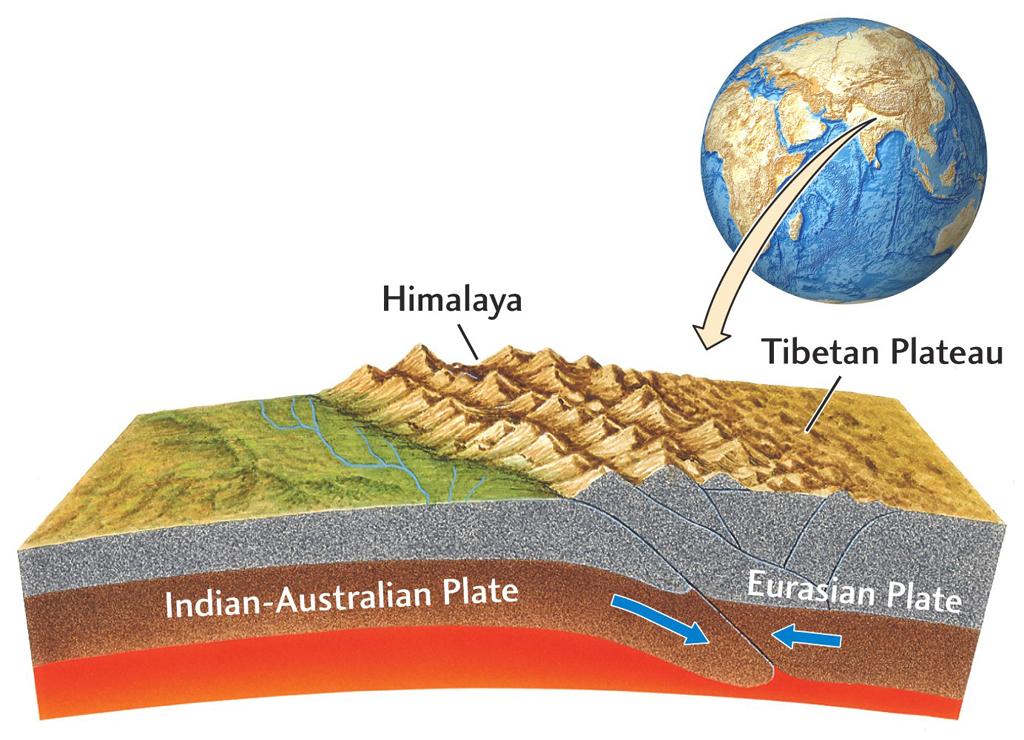
The collision with the Eurasian Plate along the boundary between India and Nepal formed the orogenic belt that created the Tibetan Plateau and the Himalaya Mountains, as sediment bunched up like earth before a plow.
The Indian Plate is currently moving north-east at 5 centimetres (2.0 in) per year, while the Eurasian Plate is moving north at only 2 centimetres (0.79 in) per year. This is causing the Eurasian Plate to deform, and the India Plate to compress at a rate of 4 millimetres (0.16 in) per year.
Formation Of Himalayas: Geologically, the Himalayas originate from the northward movement of the Indian tectonic plate at 15 cm per year to impact the Eurasian continent, with first contact about 70 million years ago, and with movement continuing today. This caused the formation of the Himalayan arc peaks: the lighter rocks of the seabeds of that time were easily uplifted into mountains. An often-cited fact used to illustrate this process is that the summit of Mount Everest is made of marine limestone.

Himalayan Impact on Climate: The Himalayas have a profound effect on the climate of the Indian subcontinent and the Tibetan plateau. They prevent frigid, dry Arctic winds blowing south into the subcontinent, which keeps South Asia much warmer than corresponding temperate regions in the other continents. It also forms a barrier for the monsoon winds, keeping them from traveling northwards, and causing heavy rainfall in the Terai region. The Himalayas are also believed to play an important part in the formation of Central Asian deserts, such as the Taklamakan and Gobi.[13]
The mountain ranges also prevent western winter disturbances in Iran from traveling further, resulting in snow in Kashmir and rainfall in parts of Punjab and northern India. Despite being a barrier to the cold, northerly winter winds, the Brahmaputra valley receives part of the frigid winds, thus lowering the temperature in the North East India and Bangladesh.


Himalayan Impact On Culture: Some of the world's major rivers, the Ganges, Indus, Brahmaputra, Yangtze, Mekong, Salween, Red River (Asia), Xunjiang, Chao Phraya, Irrawaddy River, Amu Darya, Syr Darya, Tarim River and Yellow River, arise in the Himalayas, and their combined drainage basin is home to some 3 billion people (almost half of Earth's population) in Afghanistan, Bangladesh, Bhutan, People's Republic of China, India (almost half of the population of India live within 500 km of the Himalayan range),[citation needed], Nepal, Burma, Cambodia, Tajikistan, Uzbekistan, Turkmenistan, Kazakhstan, Kyrgyzstan, Thailand, Laos, Vietnam, Malaysia and Pakistan.

Sub Himalayan Plains Became A Fertile Place For Sustaining Rich Human Civilizations To Rise Along The Rivers:
Aryan Civilization:  
Aryan is an English language loanword derived from the Sanskrit ārya ('Noble'). In present-day academia, the terms "Indo-Iranian" and "Indo-European" have, according to many, made most uses of the term 'Aryan' minimal, and 'Aryan' is now mostly limited to its appearance in the term "Indo-Aryan" to represent (speakers of) North, West and Central Indian languages.
"Aryan"  it was used initially as a national name to designate the worshippers of the Hindu deities and especially Indra according to Brahmanical principles (performance of sacrifice, Yajna). The Zend airya 'venerable' and Old Persian ariya are also considered as national names.
 

Aryan Civilization a continuity of Indus Valley Civilization: 

1. Similarities between Indus valley civilization and aryan civilization:
  1. Indus valley civilization script though not understood till date has symbols such as 'OM' and 'swastika' which are used extensively in vedas. IVC script is actually pre sanskrit script.
  2. Worshiping of idols, trees, animals, snakes and animal sacrifices to please gods are found to be common in two civilizations.
  3. yoga postures found in vedas and pictures of god in same position found in ruins of IVC are similar.
  4. Love for jewellery, bathing in large pool etc.. are still practiced in india today gives weight age to cultural continuance.
  5. 2500 archaeological sites of IVC have no literature associated with them which implies ivc transferred their knowledge orally, this form of passing knowledge from one generation to another orally was started more than 10,000 years ago in India
2. Short comings of aryan invasion theory:
  1. No aryan homeland outside india was found and also not mentioned in vedas.
  2. 3000B.C was period Rig Veda belonged not 1200 B.C as previously predicted according to latest findings. So, Rig veda the basic literature of aryans could not have been present 1800 years before the aryans invaded india. therefore giving light to the cultural continuance of IVC and erroneous theory of aryan invasion.
  3. Rig veda also talks about saraswati river, drying of river and continuance of civilization southwards towards indi-gangetic plain. 
  4. Satellite image shows ruins of ancient river bed across IVC cities known to be the same saraswati river mentioned in Rig veda which dried up the same time aryans occupied the indo-ganetic plain. This can be taken as conclusive evidence of IVC being migrated to Indo-gangetic plain which later came to be known as aryan civilization. 
  5. Max Muller who proposed 'aryan invasion theory' himself acknowledged that indian literature has unique place in history which contradicts his theory that states indian literature was imported by aryans from their homeland in europe.
  6. Sanskrit is actually mother of all european languages but the opposite is being spread by vested interests.
  7. Indus valley civilization  was the most advanced civilization at that time, it had some of the largest cities in the world at that time and is referred as urban civilization. An advanced civilization being destroyed by a tribe from europe is hard to digest.
  8. there are genetic similarities present between today's indians and  Indus valley civilization people.
  9. Misinterpretation and Knowingly ignoring the similarities between IVC and aryan civilization to establishing european supremacy.

Sunday, August 5, 2012

Water (H2O): A Mysterious Molecule

Water may be one of the most familiar substance on the planet, but it certainly isn't ordinary. In fact, water's unique chemical properties make it so complicated that even after decades of research, scientists still have much to learn about this remarkable and versatile substance.


If we drop an ice cube into a glass of water, it floats. This happens because water expands as it freezes, which makes the solid form less dense than the liquid. But most other liquids do just the opposite; they shrink and become more dense as they freeze, so the solid form sinks. If water behaved that way, ice would accumulate on the bottom of lakes and oceans during the winter, and would have difficulty thawing in the spring. If possible, this would have consequences for aquatic life.
 Another surprising characteristic of water is that it boils at a very high temperature—100 degrees Celsius at sea level—compared to similarly sized molecules. If water behaved like other liquids, it would exist as a gas at the temperatures and pressures found on Earth, and life as we know it couldn’t survive.

Water is all around us—in the sky, on the ground, in the air—continually changing form. Water's unique chemical properties make it the only natural substance that can be found in all three states: liquid, solid (ice) and gas (steam). The continual movement of water around the globe is known as the hydrologic cycle. Several processes take place within this cycle, including evaporation, condensation, precipitation, runoff and collection. During the cycle, water will change form many times.
 
That’s water, as in the clear, sparkling fluid that covers three quarters of the Earth’s surface—not to mention the basis of life as we know it, and possessor of the world’s most recognizable chemical formula (H2O). Water is everywhere. And yet, scientists are still learning about its properties.  
Unique & mysterious properties: 
1. Enthalpy of vaporization:
Water has a very high specific heat capacity – the second highest among all the heteroatomic species (after ammonia), as well as a high heat of vaporization (40.65 kJ/mol or 2257 kJ/kg at the normal boiling point), both of which are a result of the extensive hydrogen bonding between its molecules. These two unusual properties allow water to moderate Earth's climate by buffering large fluctuations in temperature. According to Josh Willis, of NASA's Jet Propulsion Laboratory, the oceans absorb one thousand times more heat than the atmosphere (air) and are holding 80 to 90% of global warming heat.
 The specific enthalpy of fusion of water is 333.55 kJ/kg at 0 °C. Of common substances, only that of ammonia is higher. This property confers resistance to melting on the ice of glaciers and drift ice. Before and since the advent of mechanical refrigeration, ice was and still is in common use for retarding food spoilage.
 2. Density of water and ice:
The density of water is approximately one gram per cubic centimeter. It is dependent on its temperature, but the relation is not linear and is unimodal rather than monotonic (see table at left). When cooled from room temperature liquid water becomes increasingly dense, as with other substances, but at approximately 4 °C (39 °F), pure water reaches its maximum density. As it is cooled further, it expands to become less dense. This unusual negative thermal expansion is attributed to strong, orientation-dependent, intermolecular interactions and is also observed in molten silica.
Water also expands significantly as the temperature increases. Water near the boiling point is about 96 percent as dense as water at 4°C.
These properties of water have important consequences in its role in Earth's ecosystem. Water at a temperature of 4°C will always accumulate at the bottom of freshwater lakes, irrespective of the temperature in the atmosphere. Since water and ice are poor conductors of heat (good insulators) it is unlikely that sufficiently deep lakes will freeze completely, unless stirred by strong currents that mix cooler and warmer water and accelerate the cooling. In warming weather, chunks of ice float, rather than sink to the bottom where they might melt extremely slowly. These properties therefore allow aquatic life in the lake to survive during the winter.
 3. Density of saltwater and ice:
The density of water is dependent on the dissolved salt content as well as the temperature of the water. Ice still floats in the oceans, otherwise they would freeze from the bottom up. However, the salt content of oceans lowers the freezing point by about 2 °C and lowers the temperature of the density maximum of water to the freezing point. This is why, in ocean water, the downward convection of colder water is not blocked by an expansion of water as it becomes colder near the freezing point. The oceans' cold water near the freezing point continues to sink. For this reason, any creature attempting to survive at the bottom of such cold water as the Arctic Ocean generally lives in water that is 4 °C colder than the temperature at the bottom of frozen-over fresh water lakes and rivers in the winter.
 In cold countries, when the temperature of fresh water reaches 4 °C, the layers of water near the top in contact with cold air continue to lose heat energy and their temperature falls below 4 °C. On cooling below 4 °C, these layers do not sink but may rise up as fresh water has a maximum density at 4 °C. (Refer: Polarity and hydrogen bonding) Due to this, the layer of water at 4 °C remains at the bottom and above this layers of water 3 °C, 2 °C, 1 °C and 0 °C are formed. Since ice is a poor conductor of heat, it does not absorb heat energy from the water beneath the layer of ice which prevents the water freezing. Thus, aquatic creatures survive in such places.

Saturday, July 28, 2012

Water (H2O): A Life Sustaining Molecule


Every life form on earth began in water, no life exists without it:
1. Our histology & physiology as an evidence.
When animal moved from the sea to dry land, it took millions of years of evolution, the sea "came with them", even now  millions of years later our body liquid still resembles sea water, we started life in a bag of water at the same temperature as our mother's body, the bag eventually bursts and we are born and new life it breathed into us and suddenly we are a real person relying on air to survive leaving water to take second place, but none the less vitally important as it still makes up over 70% of our body, so for an average healthy adult that sums up to about forty plus litres.
Three litres of our water circulates in our blood with another nine litres exchanging freely with it that are distributed throughout our body tissues but remain outside of them, this twelve litres resembles the "sea that came with us
Two litres of water pass into our reservoir every day, and an equal amount passes out as urine and perspiration, this exchange brings in our food, vitamins and mineral requirements and also flushes toxins from the body, controlled carefully by the kidneys and our hormone system to keep (hopefully) our body cells in top condition.
These cells contain the remaining 30 litres of body fluid.
 

The Miraculous Properties of Water:
Water has many exceptional chemical properties. Every water molecule forms by the combination of hydrogen and oxygen atoms. It is quite interesting that these two gases, one combustive and the other combustible, combine to form a liquid, and most interestingly, water.
 

1. The water molecule: the hydrogen bonds.
 

Now, let us briefly see how water is formed chemically. The electrical charge of water is zero, that is, it is neutral. Yet, due to the sizes of the oxygen and hydrogen atoms, the oxygen component of the water molecule has a slightly negative charge and its hydrogen component has a slightly positive charge. When more than one water molecule come together, positive and negative charges attract each other to form a very special bond called "the hydrogen bond". The hydrogen bond is a very weak bond and it is incomprehensibly short-lived. The duration of a hydrogen bond is approximately one hundred billionth of a second. But as soon as a bond breaks, another one forms. Thus, water molecules adhere tightly to each other while also retaining their liquid form because they are combined with a weak bond. 
2. High thermal energy: the hydrogen bonds.
 
Hydrogen bonds also enable water to resist temperature changes. Even if air temperature increases suddenly, water temperature increases slowly and, similarly, if air temperature falls suddenly, water temperature drops slowly. Large temperature changes are needed to cause considerable changes in water temperature. The significantly high thermal energy of water has major benefits for life. To give a simple example, there is a great amount of water in our bodies. If water adapted to the sudden vicissitudes of temperature in the air at the same rate, we would suddenly develop fevers or freeze.  
By the same token, water needs a huge thermal energy to evaporate. Since water uses up a great deal of thermal energy while evaporating, its temperature drops. To give an example, again from the human body, the normal temperature of the body is 36º C and the highest body temperature we can tolerate is 42º C. This 6º C interval is indeed very small and even working under the sun for a few hours can increase body temperature by that amount. Yet, our bodies spend a great amount of thermal energy through sweating, that is, by causing the water it contains to evaporate, which in turn causes body temperature to drop. If our bodies did not have such an automatic mechanism, working for even a few hours under the sun could be fatal.

3. A more viscous liquid: the hydrogen bonds.
 

Hydrogen bonds equip water with yet another extraordinary property, which is water's being more viscous in its liquid state than in its solid state. As a matter of fact, most substances on earth are more viscous in their solid states than in their liquid states. Contrary to other substances, however, water expands as it freezes. This is because hydrogen bonds prevent water molecules from bonding to each other too tightly, and thus many gaps are left in between them. Hydrogen bonds are broken down when water is in liquid state, which causes oxygen atoms to come closer to each other and form a more viscous structure.

An Interesting Property of Water:
1. An unique oxygen hydride.

We all know that water boils at 100º C and freezes at 0º C. In fact, under normal circumstances, water should be boiling not at 100º C but at + 180º C. Why? 
In the periodic table, the properties of elements in the same group vary in a progressive form from light elements towards heavy elements. This order is most evident in hydrogen compounds. The compounds of the elements sharing the same group with oxygen in the periodic table are called "hydrides". In fact, water is "oxygen hydride". Hydrides of other elements in this group have the same molecular structure as the water molecule.
The boiling points of these compounds vary in a progressive way from sulphur to heavier ones; however, the boiling point of water unexpectedly goes against this pattern. Water (oxygen hydride) boils at 80º C less than it is supposed to. Another surprising situation has to do with the freezing point of water. Again, according to the order in the periodic system, water is supposed to freeze at - 100º C. Yet, water breaks this rule and freezes at 0º C, 100º C above the temperature at which it is due. This brings to mind the question as to why no other hydride, but only water (oxygen hydride) disobeys the rules of the periodic system.

Sunday, July 22, 2012

Water (H2O)

Wednesday, March 14, 2012

Multiple Worlds: Physics Vs. Metaphysics


Quantum Theory: This theory states that every particle is everywhere unless the particle is being observed.

Wave Particle Duality: Particle and waves are neither one nor the other, but had certain properties of both.

Einstein's Observation: Physical objects are not in space, but these objects are spatially extended. In this way the empty space loses it's meaning.

Hugh Everett: He invented a quantum theory of Multiple Universes. His theory of independent parallel universes states clearly that:
# The reality of Multiple World is so as they are present in the same Time & Space coordinate, in which we are.
# Big Bangs are always happening in the Multiple Universes and Universes are being formed continuously.
# Parallel Universes may be bring horrible catastrophe too.
# Everett envisaged the concept of Quantum Immortality, as every second an individual is multi-furcating into so many.

Quantum Discoherence: However according to the theory of quantum discoherence, the Parallel Universes will never be accessible to us in our own Time & Space. We shall be able to observe one world only at a given Time & Space.

The Question Is: Why can some scientists believe in physical parallel universes, but find it hard to accept a non physical one ?

A Turning Point: ..comes when we see how subtly Science (Physics) corroborates with the other world idea of Religion (Metaphysics).

Emily Dickinson's one short poem just defines the spirit behind this thought and possible alternative theory, is:
"Faith a fine invention, for gentlemen who see;
But microscopes are prudent, in an emergency."

Some Quotes From Scriptures Spiritual:
# O My Friends !
Have ye forgotten that true and radiant morn, when in those hallowed and blessed surroundings ye were all gathered in My presence beneath the shade of the tree of life, which is planted in the all glorious paradise? Awe-struck ye listened as I gave utterance to....
(from the writings of Baha'i Faith)
# Almost all religious prayers talk about this world and the world to come..
# Metaphorically this is a sort of clear indication of the existence of many worlds spiritually and the journey of life continues hence after this life, which is referred as the Quantum Immortality by the Physicist Hugh Everett.

Pictures:
from top to down: Albert Einstein, Hugh Everett, Lotus Temple-a Baha'i House of worship in India.

Wednesday, February 29, 2012

Hugh Everett: A Man Much Before Of His Time


Duality Of Light: We discovered that all the small particles that collectively construct our world travel through space as probability waves. Instead of traveling from point A to point B like a thrown baseball, today we understand that light behaves in some ways like a solid particle when it interacts with other particles, however, when light travels from place to place, like a wave in an ocean it has no definite position. In fact, even matter particles, such as the particles that make up our bodies, regularly disappear between one position and the next.

Uncertainty Principle: One of the founders of quantum theory, Werner Heisenberg discovered what is now a key principle concerning all quantum behavior. As a particle gives up information about its location, information about its momentum is lost in equal measure. This is called the Heisenberg uncertainty principle, which states that both the position and momentum of a particle cannot be known. The more we know about one, the less we know about the other. So as a rule, whenever a particle assumes a precise position in reality, in that instant it has no momentum. And whenever a particle is moving from one place to another, it has no specific location. Only when the particle interacts with something else does it then establish which physical reality we will experience, but in between interactions the particle exists in another type of reality, a sort of multiplicity where all possibilities are combined together.

Quantum Theory Of Mechanics: Quantum theory was developed near the turn of the century and it wasn’t until 1957 that all the possibilities within each quantum wave led a young graduate student of physics named Hugh Everett III to produce the now famous Many-Worlds Theory as his doctorate thesis. Everett was a student of John Archibald Wheeler, the renowned American physicist and longtime Professor at Princeton. The Many-Worlds Theory makes the simple conclusion that one probabilistic outcome is as real as any other, predicting an immense surplus of many-worlds branch away from each moment of now.

Many Worlds: We can imagine an infinite number of copies identical to our present, but then in the next moment, in each copy there is one single particle that is in a slightly different position than all the others. The denser areas of probability in the interference pattern represent the more probable worlds, while the thin areas represent the least probable worlds. The areas outside the wave pattern that are completely dark can be thought of as worlds outside the realm of quantum possibility.

Reasonable Criticism:
Some scientists shrug at the Many-Worlds Theory and continue to believe there is something that makes quantum reality operate only at the subatomic level, and not at a macrocosmic level where we live. But the technological applications of quantum mechanics to chemistry and electronics have already had a tremendous impact upon society. In addition to television shows and movies where characters cross over into parallel universes, physicists are working toward a complete quantum description of reality. If a complete theory is ever accomplished, it will explain why certain things are possible while others are less so, and it will tell us what is impossible. Presently, the Many-Worlds Theory does not claim that other worlds with different laws and forces of nature cannot exist, but if the probabilities of quantum mechanics were found to be basic to nature then we would reasonably conclude the same laws govern all of existence.

Troubled Private And Professional Life: Hugh Everett was a brilliant mathematician, an iconoclastic quantum theorist and later a successful defense contracter.
He introduced a new conception of reality to physics and influenced the course of world history: the man who invented a quantum theory of multiple universes.

After his new theory of multiple universes met scorn, Hugh Everett abandoned the world of academic physics. He turned to top secret military research and led a tragic private life.
To his children he was someone else again: an emotionally unavailable father; "a lump of furniture sitting at the dining room table", cigarette in hand. He was also a chain-smoking alcoholic who died prematurely in 1982 at the age of 51.

Monday, February 20, 2012

Einstein's Quantum Mechanics: Everett's Parallel Universes


Quantum Mechanics: Broadly speaking, quantum mechanics incorporates four classes of phenomena for which classical physics can not account:
# The quantization of certain physical properties,
# Wave-particle duality,
# The uncertainty principle,
# Quantum entanglement.

The Wave-Particle Duality: It provides a mathematical description of much of the dual particle-like and wave-like behavior and interactions of energy and matter.
The wave-particle duality of energy & matter and the uncertainty principle provides a unified view of the behavior of photons, electrons and other atomic scale objects. Quantum theory states that every particle is everywhere unless the particle is being observed.
An electromagnetic wave such as light could be described as particle-later called the photon-with a discrete quanta of energy that was dependent on it's frequency. This led to a theory of unity between subatomic particles and electromagnetic waves called wave-particle duality in which particle and waves were neither one nor the other, but had certain properties of both.

Albert Einstein's Observation: Physical objects are not in space, but these objects are spatially extended. In this way the concept of empty space loses it's meaning.

Philosophical Interpretations: The Everett many-worlds interpretation, formulated in 1956 holds that all the possibilities described by quantum theory simultaneously occur in a multiverse composed of mostly independent parallel universes. While the multiverse is deterministic, we perceive non-deterministic behavior governed by probabilities, because we can observe only the universe, i.e. the consistent state contribution to the mentioned super position, we inhabit. Everett's interpretation is perfectly consistent with John Bell's experiment and makes them intutively understandable. However, according to the theory of quantum discoherence, the parallel universes will never be accessible to us.

Note:
# Pic 2 from top; Probability densities corresponding to the wavefunctions of an electron in a hydrogen atom possessing definite energy levels and angular momentum.
# Bottom picture; Some trajectories of a harmonic oscillator in a classical mechanics and quantum mechanics.

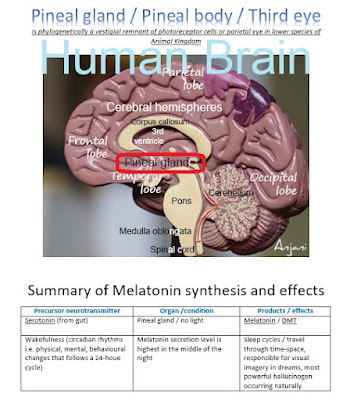
Pineal gland, the mystical third eye

Pineal gland   It is a very small unpaired midline brain structure of endocrine gland, tiny as a rice grain size, situated laterally (anatom...