Showing posts with label Neurotransmitters. Show all posts

Wednesday, February 1, 2023

Happy chemicals of human body

Happiness is a very illusive term in human case as affecting variable are many. 
But for sure, happy people are more successful in multiple life domains.

  • Physical, mental, emotional well-being is being governed or influenced by many external and internal factors, more often not in our control. 
  • That's why this subject spans a lot many areas of external environmental factors and inner body chemistry. 
  • Subjective well-being is all in the center of evaluation of happiness, positive and negative emotions are the end results.

Primary signaling chemicals of mood in humans are 4 (Neurotransmitter Hormones) as below:
  1. Serotonin, the mood stabilizer (neurotransmitter).
  2. Oxytocin, the love hormone (hormone).
  3. Dopamine, the rewarding chemical (neurotransmitter).
  4. Endorphins, the pain killer (neurotransmitter).


Tips for living a happy life:
  • Eat nourishing food, be in nature, exposure to sun shine, meditate for the feel good hormone (Serotonin).
  • Keep company with good people, family, pet, love, laugh for the love hormone (Oxytocin).
  • Do something meaningful each day with short and long term goal for the reward chemical (Dopamine).
  • Get regular exercise, avoid news overdose, switch off bright screen - hours before bedtime, goodnight sleep of 6 to 8 hours every night for relaxing, pain killer (Endorphins).

----------------------------------------------------------------------------------------------------------
Interesting notes:
-----------------------
Endorphins evolved in nature for survival. 
Injured animal run from predator or our ancestor's ran for help or to search for a source of water at any undisclosed distant places or a runner push through a race even in injury and likewise. 
Endorphin is produced in pain doesn't mean that one should inflict pain or harm oneself or over exercising beyond one's limit to feel good. Laughing out loud, meditation, working out in moderate, watching your favorite drama could help you to achieve this endorphin feel good effect.
Endorphins and dopamine: Endorphins relieve pain and dopamine motivates to push through challenges and provides a reward for doing so.
Opiates trigger the same receptor in the brain that triggers the release of endorphins. 
As endorphins binds pain signals and relieves, dopamine will motivate you to do same thing over and over again. So endorphins and dopamine actually work together. 
Out of more than 20 endorphins in our body, Beta endorphin is having stronger effect than morphine. That way the 'runner's high' exercise addiction and self harm could be understood

Thursday, September 3, 2015

Addiction is a brain game

Chemistry of the brain regulates our thinking, behavior, and feelings through neurotransmitters.

Addiction is a result of impaired brain chemistry.

Neurotransmitters linked to addiction are;Serotonin, Dopamine, GABA, Endorphins, Norepinephrin, to lesser extent Acetylcholine and Anandamide.

Functions of these neurotransmitters are:
Serotonin; natural anti-depressant, provides feelings of well being and inner peace
Dopamine; pleasure feeling, motivation, focus, provides feelings of well being and inner peace
GABA; natural sedative, relaxation, provides feelings of well being and inner peace
Endorphins; natural opiates, relief for physical and emotional pain, provides feelings of well being and inner peace
Norepinephrin; provides energy, provides feelings of well being and inner peace
Acetylcholine; regulates autonomic nervous system, cognitive functions and memory
Anandamide; dampening effect on all other neurotransmitters

Happiness and well being and sense of inner peace is a brain function when these neurotransmitters are produced in just balanced quantity required so for an individual.

Neurotransmitters imbalance may be caused due to poor diet, nutritional deficiency, genetic polymorphism, chronic stress, childhood abuse, environmental toxins, brain trauma (concussion),

Neurotransmitters imbalance symptoms includes; depression, anxiety, irritability, violence, inability to concentrate or remember, insomnia, hyperactivity, cravings for mind-altering substances of all kind.

Psychotropic substances artificially and temporarily alter neurotransmitters in the brain by:
i. stimulating an intense supply of neurotransmitters to be released all at once,
ii. mimic the effect of natural transmitters.

For example:
a. sugar and alcohol increases dopamine, serotonin, GABA, endorphins.
b. marijuana and chocolates affects anandamide.
c. nicotine affects acetylcholine.
d. cocaine and amphetamines increase dopamine.
e. ativan/valium mimic GABA.

Sense of well being, inner peace, pleasure, joy, happiness by alleviating physical and emotional pain is the net gain of these addictive substances by altering the neurotransmitter.

Addiction explained by Charles Gant, "brain responds to artificial stimulation of neurotransmitters by either reducing production of and responsiveness to the particular neurotransmitter or reducing the number of receptors for the neurotransmitters. This leaves the brain dependent upon the psychotropic substance to perform the duties of the impaired transmitter." 

Addict brain is not producing or responding it's own natural neurotransmitters then craving and withdrawal symptoms appear for the addictive substance to carry out the functions of depleted neurotransmitters.

Restoring the balance of neurotransmitters is the answer to get out of the addictive habit, by choosing: 
i. right diet
ii. nutritional supplement
iii. change in life style
picture credit:http://www.healingartsnyc.com/sugar_addictoin
studies confirm a food addict's brain operates similarly to a drug addict

Thankfully consulted and shared from:
http://www.drugabuse.gov/publications/drugs-brains-behavior-science-addiction/preface
http://www.drugabuse.gov/related-topics/addiction-science
http://www.naturalnews.com/041140_addiction_brain_chemistry_mental_health.html

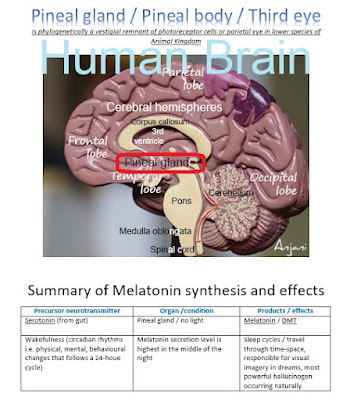
Pineal gland, the mystical third eye

Pineal gland   It is a very small unpaired midline brain structure of endocrine gland, tiny as a rice grain size, situated laterally (anatom...