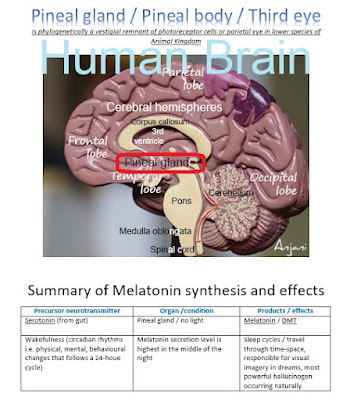
CONTROL & COORDINATION
1. Endocrine System; of Endocrine glands, Hormones secreted by goes directly into blood stream.
2. Nervous System; of Nerve cell/Neuron, through nerve impulses.
CONTROL & COORDINATION BY NERVOUS SYSTEM
a. Tissues
b. Organ
c. Systems (Organ Systems)
2. Perception of environment through sensory stimulus received by 'Sensory Organs'
DIVISIONS OF NERVOUS SYSTEM
A. CENTRAL NERVOUS SYSTEM
a. Brain
b. Spinal Cord
B. PERIPHERAL NERVOUS SYSTEM
a. Cranial Nerves
i. 12 pairs
ii. Sensory, Motor, Mix types
b. Spinal Nerves
i. 31 pairs
ii. Sensory from the Dorsal Root
iii. Motor from the Ventral Root
C. AUTONOMIC NERVOUS SYSTEM
Never are they connected to any body organ diectly
Are of 2 Neurons type:
Preganglionic Nerves and Post Ganglionic Nerves
Autonomous Nervous System is of two types:
a. Sympathetic or Thoracolumber system
Chest and lumber region
b. Parasympathetic or Craniosacral system
________________________________________________________________________
CENTRAL NERVOUS SYSTEM
comprising 2 main structures
1. Brain
(enclosed in bony skeleton of Cranium)
2. Spinal Cord
(enclosed in bony skeleton of Vertibral Column)
Meninges, the three layered connective tissue membrane covers Brain and Spinal Cord both from outside. These membranes of Meninges are Duramater, Arachnoid and Piamater from outside to inside.
Piamater joining brain surfaces in the brain cavity, at two places it forms finger like inward projection inside brain, called Choroid Plexus.
Cerebrospinal Fluid (CSF),
is a kind of lymph
acts as to and fro communicating medium between blood and brain cells
protects brain and spinal cord from external shocks.
________________________________________________________________________
Brain
1400 grams in weight, approximately
Enclosed in the Cranium of bone
Bilaterally symmetrical
Made of Neuron, which is
i. Grey Matter, outside portion of brain, comprising Cyton of Neuron
ii. White Matter, inside portion of brain, comprising Nerve Fibre of Neuron
It is divisible into 3 main parts:
a. Fore Brain (Prosencephalon)
i. Cerebrum
ii. Diencephalon
b. Mid Brain (Mesencephalon)
i. Cerebral peduncle
ii. Corpora quadrigemina
c. Hind Brain (Rhombencephalon)
i. Cerebellum
ii. Pons
iii. Medulla oblongata
a. Fore Brain (Prosencephalon)
i. Cerebrum
Left and Right, two Cerebral Hemisphere
Both separated from each one by a long groove in centre
Both hemisphere are attached to each other by a Neuron plate called Corpus Callosum
This form 2/3 or 7/8 part of all brain
Each Cerebral Hemisphere is divisible in 4 lobes by three deep grooves, as
i. Frontal lobe
ii. Parietal lobe
iii. Temporal lobe
iv. Occipital lobe
Cerebral Cortex
Outer region of Cerebral hemisphere, made of Grey Matter, numerous Neurons
Gyri and Sulci
The folds formed in this part are called Gyri and Sulci
Protrding part of tghe fold is Gyri and sunken part is called Sulci
This is 1.5-4 mm in thickness
This enables the packing of nemerous Neurons in a small place
If this part extended, cover 4000 sq. cm., comprising 10-14 billion Neurons
Cerebral Nuclei
Islands of Grey Matter are found in the White Matter are called Cerebral Nuclei

Function of Cerebrum
Frontal lobe is General Motor area while other lobes are General Sensory Area in function.
 Premotor Area of Frontal Lobe controls movement of Unstriped muscles while Motor area controls the movement of Striped muscles.
Somaesthetic area of Parietal lobe is a centre of cold, hot, touch, light reflexes.
Temporal lobe governs smell and taste.
Occipital lobe is for sight and hearing.
Cerebrum stands for all for which humans are recognized as special from rest of the life forms, that is
Conscience, Intellect, Thinking, Memory, Desires, Control on various emotion, Control on laugh and weep, Understandind,Understandind and decision making in respect of sensory and other perceptions.
There are separate cenre for each sensory impulses received in Cerebrum.
ii. Diencephalon
This is the hind part of the Fore Brain
It is small, rectangular in shape
It is fully covered by Cerebral hemisphere from dorsal side front portion, while it is covered by Mid brain from behind
The ventricle is called as Third Ventricle or Diocoel
This is made up by two structures:
# Thalamus: two round projections of Grey Matter in Diocoel
# Hypothalamus: at the bottom surface of Diocoel, islands of Grey Matter in White Matter
 Functions
1. Thalamus
Sending Sensory and Motor stimulus from Medulla oblongata and Spinal cord to Cerebrum
Controls emotions, heat, cold, pain
2. Hypothalamus
Coordination between Nervous system and Endocrine system
Controls Autonomous Nervous system
Control on Carbohydrate and Fat metabolism
b. Mid Brain (Mesencephalon)
i. Cerebral Peduncle
A thick path of Nerve fibres which connects Cerebrum and Cerebellum
It's ventricle is called Iter which connects third ventricle of Diencephalon to fourth ventrile of Medulla
Functions:
a. Reflex centre
b. Sending Motor stimulus of Cerebrum to limbs
ii. Corpora Quadrigemina
Four, solid, round protuberance found on the dorsal surface of mid brain
Functions:
a. Sight and smell reflex centre

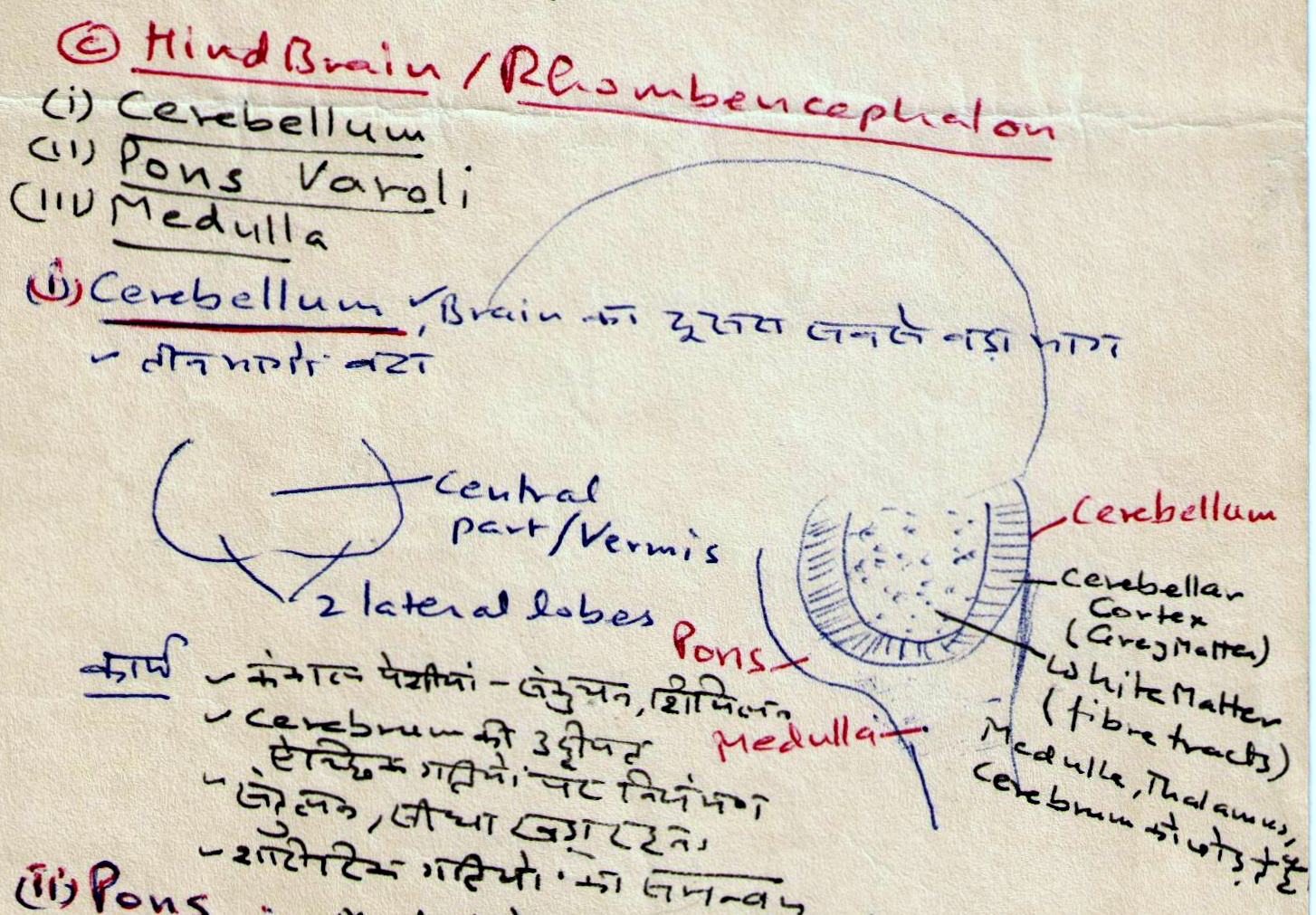
c. Hind Brain (Rhombencephalon)
i. Cerebellum
This is second largest part of the brain
Divisible into three parts
Cerebellar cortex is made of Grey Matter
Central Fibre tract is made of White Matter
a. Vermis, central part
b. Lateral lobes, two in number
Functions:
Contraction and relaxation of Skeletal muscle
Control on voluntary movement initiated by Cerebrum
Body balance, to be in upright position
Coordination in movements of body
ii. Pons Varoli
Pons are found in upper and front part
This is in form of thick poo; of nerve fibres
Joints left and right lobes of Cerebellum
Controls muscle movements of both sides of the body

iii. Medulla
This is hind most part of the brain, also called Brain Stem
Lateral walls are thick, made of White Matter
Islands of Grey Matter on ventral surface with neurons
Functions:
a. Vital Centre
Respiratory centre
Cardiac centre
Gastric centre
b. Reflex centre
Swallowing centre
Vomitting centre
Choking centre
Salivary centre
Sending Spinal nerve stimulus, from Spinal cord to Brain
________________________________________________________________________
Ventricles of the brain are as labelled in diagram below

1. Endocrine System; of Endocrine glands, Hormones secreted by goes directly into blood stream.
2. Nervous System; of Nerve cell/Neuron, through nerve impulses.
CONTROL & COORDINATION BY NERVOUS SYSTEM
Mainly functions as:
1. Control & coordination of/amonga. Tissues
b. Organ
c. Systems (Organ Systems)
2. Perception of environment through sensory stimulus received by 'Sensory Organs'
DIVISIONS OF NERVOUS SYSTEM
A. CENTRAL NERVOUS SYSTEM
a. Brain
b. Spinal Cord
B. PERIPHERAL NERVOUS SYSTEM
a. Cranial Nerves
i. 12 pairs
ii. Sensory, Motor, Mix types
b. Spinal Nerves
i. 31 pairs
ii. Sensory from the Dorsal Root
iii. Motor from the Ventral Root
C. AUTONOMIC NERVOUS SYSTEM
Never are they connected to any body organ diectly
Are of 2 Neurons type:
Preganglionic Nerves and Post Ganglionic Nerves
Autonomous Nervous System is of two types:
a. Sympathetic or Thoracolumber system
Chest and lumber region
b. Parasympathetic or Craniosacral system
________________________________________________________________________
CENTRAL NERVOUS SYSTEM
comprising 2 main structures
1. Brain
(enclosed in bony skeleton of Cranium)
2. Spinal Cord
(enclosed in bony skeleton of Vertibral Column)
Meninges, the three layered connective tissue membrane covers Brain and Spinal Cord both from outside. These membranes of Meninges are Duramater, Arachnoid and Piamater from outside to inside.
Piamater joining brain surfaces in the brain cavity, at two places it forms finger like inward projection inside brain, called Choroid Plexus.
Cerebrospinal Fluid (CSF),
is a kind of lymph
acts as to and fro communicating medium between blood and brain cells
protects brain and spinal cord from external shocks.
 |
| Brain covered from outside to inside as, Cranium (bone), with 3 layers of meninges (Duramater, Arachnoid, Piamater) with their spaces Epineural, Subneural, Subarachnoid spaces. Subneural space is full of reticulum of bood capillaries and blood sinuses. |
Brain
1400 grams in weight, approximately
Enclosed in the Cranium of bone
Bilaterally symmetrical
Made of Neuron, which is
i. Grey Matter, outside portion of brain, comprising Cyton of Neuron
ii. White Matter, inside portion of brain, comprising Nerve Fibre of Neuron
It is divisible into 3 main parts:
a. Fore Brain (Prosencephalon)
i. Cerebrum
ii. Diencephalon
b. Mid Brain (Mesencephalon)
i. Cerebral peduncle
ii. Corpora quadrigemina
c. Hind Brain (Rhombencephalon)
i. Cerebellum
ii. Pons
iii. Medulla oblongata
a. Fore Brain (Prosencephalon)
i. Cerebrum
Left and Right, two Cerebral Hemisphere
Both separated from each one by a long groove in centre
Both hemisphere are attached to each other by a Neuron plate called Corpus Callosum
This form 2/3 or 7/8 part of all brain
 |
| Right and Left Cerebral Hemisphere, showing Corpus Callosum |
i. Frontal lobe
ii. Parietal lobe
iii. Temporal lobe
iv. Occipital lobe
 |
| Left and Right Cerebral Hemisphere of Cerebrum separated by Median Dorsal Line in Ventral and Dorsal view |
Cerebral Cortex
Outer region of Cerebral hemisphere, made of Grey Matter, numerous Neurons
Gyri and Sulci
The folds formed in this part are called Gyri and Sulci
Protrding part of tghe fold is Gyri and sunken part is called Sulci
This is 1.5-4 mm in thickness
This enables the packing of nemerous Neurons in a small place
If this part extended, cover 4000 sq. cm., comprising 10-14 billion Neurons
Cerebral Nuclei
Islands of Grey Matter are found in the White Matter are called Cerebral Nuclei

Function of Cerebrum
Frontal lobe is General Motor area while other lobes are General Sensory Area in function.

Somaesthetic area of Parietal lobe is a centre of cold, hot, touch, light reflexes.
Temporal lobe governs smell and taste.
Occipital lobe is for sight and hearing.
Cerebrum stands for all for which humans are recognized as special from rest of the life forms, that is
Conscience, Intellect, Thinking, Memory, Desires, Control on various emotion, Control on laugh and weep, Understandind,Understandind and decision making in respect of sensory and other perceptions.
There are separate cenre for each sensory impulses received in Cerebrum.
ii. Diencephalon
This is the hind part of the Fore Brain
It is small, rectangular in shape
It is fully covered by Cerebral hemisphere from dorsal side front portion, while it is covered by Mid brain from behind
The ventricle is called as Third Ventricle or Diocoel
This is made up by two structures:
# Thalamus: two round projections of Grey Matter in Diocoel
# Hypothalamus: at the bottom surface of Diocoel, islands of Grey Matter in White Matter

1. Thalamus
Sending Sensory and Motor stimulus from Medulla oblongata and Spinal cord to Cerebrum
Controls emotions, heat, cold, pain
2. Hypothalamus
Coordination between Nervous system and Endocrine system
Controls Autonomous Nervous system
Control on Carbohydrate and Fat metabolism
b. Mid Brain (Mesencephalon)
i. Cerebral Peduncle
A thick path of Nerve fibres which connects Cerebrum and Cerebellum
It's ventricle is called Iter which connects third ventricle of Diencephalon to fourth ventrile of Medulla
Functions:
a. Reflex centre
b. Sending Motor stimulus of Cerebrum to limbs
ii. Corpora Quadrigemina
Four, solid, round protuberance found on the dorsal surface of mid brain
Functions:
a. Sight and smell reflex centre

c. Hind Brain (Rhombencephalon)
i. Cerebellum
This is second largest part of the brain
Divisible into three parts
Cerebellar cortex is made of Grey Matter
Central Fibre tract is made of White Matter
a. Vermis, central part
b. Lateral lobes, two in number
Functions:
Contraction and relaxation of Skeletal muscle
Control on voluntary movement initiated by Cerebrum
Body balance, to be in upright position
Coordination in movements of body
ii. Pons Varoli
Pons are found in upper and front part
This is in form of thick poo; of nerve fibres
Joints left and right lobes of Cerebellum
Controls muscle movements of both sides of the body
iii. Medulla
This is hind most part of the brain, also called Brain Stem
Lateral walls are thick, made of White Matter
Islands of Grey Matter on ventral surface with neurons
Functions:
a. Vital Centre
Respiratory centre
Cardiac centre
Gastric centre
b. Reflex centre
Swallowing centre
Vomitting centre
Choking centre
Salivary centre
Sending Spinal nerve stimulus, from Spinal cord to Brain
________________________________________________________________________
Ventricles of the brain are as labelled in diagram below