Showing posts with label Free Radicals and Diseases. Show all posts

Tuesday, May 14, 2013

Dark Oxidants: Super Oxides in the depth of oceans

Indeed, our bodies aren't perfect. They make mistakes, among them producing toxic chemicals, called oxidants, in cells. We fight these oxidants naturally, and by eating foods rich in antioxidants.
All forms of life that breathe oxygen -- even ones that can't be seen with the naked eye, such as bacteria -- must fight oxidants to live.
"If they don't," says scientist Colleen Hansel of the Woods Hole Oceanographic Institution in Massachusetts, "there are consequences: 
cancer and premature aging in humans, death in microorganisms."
Now researchers have discovered the first light-independent source of superoxide. The key is bacteria common in the depths of the oceans and other dark places.

Now researchers have discovered the first light-independent source of superoxide. The key is bacteria common in the depths of the oceans and other dark places.
 
Superoxide-producing bacteria live
in dark places like the depths of 
Elkhorn Slough, Calif. 
(Credit: Scott Wankel, WHOI)
The result expands the known sources of superoxide to the 95 percent of Earth's habitats that are "dark." In fact, 90 percent of the bacteria tested in the study produced superoxide in the dark.

"Superoxide has been linked with light, such that its production in darkness was a real mystery," says Deborah Bronk of the National Science Foundation's (NSF) Division of Ocean Sciences, which co-funded the research with NSF's Division of Earth Sciences.
"This finding shows that bacteria can produce superoxide in the absence of light."


Following sites referred thankfully and reference for further detail:
#Co-authors of the paper are Julia Diaz and Chantal Mendes of Harvard University, Peter Andeer and Tong Zhang of Woods Hole Oceanographic Institution and Bettina Voelker of the Colorado School of Mines.

Saturday, September 22, 2012

Free Radicals: Cause And Concern

POLLUTION, STRESS AND FAULTY FOOD HABITS > FREE RADICALS > OXIDATIVE STRESS > INCREASED CELL DAMAGE.

Mounting scientific evidence may support the important role of free radicals in the development of some diseases. 

Free radicals are molecules or atoms that have at least one unpaired electron which usually increases the chemical reactivity of the molecule. 

Environmental radiation/stress/many other pollutants and physiological processes in the body cause free radicals to form. 


Free radicals can react with other molecules to cause cell damage or DNA mutation. 


Molecules called antioxidants protect against free radical damage. 
When antioxidants are ineffective, enzymes produced by the body work to repair free radical damage. 


Higher levels of free radicals tend to cause increased cellular damage. This effect is called oxidative stress. Oxidative stress may contribute to cardiovascular disease and cancer. 

Chemical compounds found in some foods may decrease the accumulated effects of oxidative stress, thus helping to prevent disease. 

Free Radicals: Atoms contain a nucleus, and electrons move around the nucleus, usually in pairs. A free radical is any atom or molecule that contains one or more unpaired electrons.
           The unpaired electrons alter the chemical reactivity of an atom or molecule, usually making it more reactive than the corresponding non-radical. However, the actual chemical reactivity of radicals varies enormously. 
           The hydrogen radical ([H.sup.*], the same as a hydrogen atom), which contains 1 proton and 1 electron (therefore unpaired), is the simplest free radical. Free-radical chain reactions are often initiated by removal of [H.sup.*] from other molecules. A superscripted dot is used to denote free radicals. 
Free radicals and chain reaction:  Most molecules in the body are not radicals. Hence any reactive free radical generated is likely to react with a non-radical. When a free radical reacts with a non-radical, a free-radical chain reaction results and new radicals are formed. Figure 1 shows two important reactions of this type. Attack of reactive radicals on membranes or lipoproteins starts lipid peroxidation, which is particularly implicated in the development of atherosclerosis. If hydroxyl radicals are generated close to DNA, they can attack the purine and pyrimidine bases and cause mutations. For example, guanine is converted into 8-hydroxyguanine and other products.


Free radicals and premature aging: Air pollutants rob skin cells of oxygen and cause free radical production in the skin. This, in combination with UV radiation decreases the production of collagen and elastin, causing the skin to thin and lose elasticity, leading to sagging skin, fine lines, and wrinkles.

Free radicals and diseases: Free radicals are capable of damage biomolecules, provoke immune response, activate oncogens, cause atherogenesis and enhance ageing process. However, in healthy conditions nature has endowed human body with enormous antioxidant potential. Subtle balance exists between free radical generation and antioxidant defence system to cope with oxidative stress by various enzymes and vitamins at cellular level which prevent the occurrence of disease. However, factors tilting the balance in favour of excess free radicals generation lead to widespread oxidative tissue damage and diseases. Therefore, trouble starts when there is an excess of free radicals and the defence mechanism lags behind. Overwhelming production of free radicals in response to exposure to toxic chemicals and ageing may necessitate judicious antioxidant supplement to help alleviate free radical mediated damage.
tropospheric mean concentrations of (a) O3, (b) OH, (c) H2O2 and (d) the surface Δ17O(SO42-).  The measurement locations are shown in (a).
Free radicals with pollutants: Highly reactive molecules called free radicals can cause tissue damage by reacting with polyunsaturated fatty acids in cellular membranes, nucleotides in DNA, and critical sulfhydryl bonds in proteins. Free radicals can originate endogenously from normal metabolic reactions or exogenously as components of tobacco smoke and air pollutants and indirectly through the metabolism of certain solvents, drugs, and pesticides as well as through exposure to radiation. There is some evidence that free radical damage contributes to the etiology of many chronic health problems such as emphysema, cardiovascular and inflammatory diseases, cataracts, and cancer. Defenses against free radical damage include tocopherol (vitamin E), ascorbic acid (vitamin C), beta-carotene, glutathione, uric acid, bilirubin, and several metalloenzymes including glutathione peroxidase (selenium), catalase (iron), and superoxide dismutase (copper, zinc, manganese) and proteins such as ceruloplasmin (copper). The extent of tissue damage is the result of the balance between the free radicals generated and the antioxidant protective defense system. Several dietary micronutrients contribute greatly to the protective system. Based on the growing interest in free radical biology and the lack of effective therapies for many of the chronic diseases, the usefulness of essential, safe nutrients in protecting against the adverse effects of oxidative injury warrants further study.

Free radicals with oily fried foods (through lipid oxidation): Modern industrial environments, lifestyles and poor nutrition contribute heavily to Free Radical production.  When the body is low on antioxidants Free Radicals increase.  Additionally, unprotected exposure to the sun produces Free Radicals in the skin, mental and emotional stress are key causes of Free Radicals, as is smoking, the taking of drugs of any kind (including alcohol), cooked oils or fats, exposure to petrochemicals, heavy metalsand even excess adrenaline or insulin all take part in Free Radical production in our bodies.

WHAT CAN STOP A FREE RADICAL? (ANTIOXIDANTS): A free radical is stopped when the electron difference (gaining or losing an electron) is corrected.  Molecules that can correct the electron difference are called Antioxidants.  The process of damage by Free Radicals is called oxidation (think rust on metal or the browning of a cut apple), and the process that prevents it is anti-oxidation, and the molecules which do the prevention are called Antioxidants. Antioxidants are found in dark colored vegetables and fruit and in dietary supplements. The life of a free radical has three stages: the initiation stage, propagation stage, and finally the termination stage. Free radicals are terminated or neutralized by nutrients (antioxidants), enzymatic mechanisms, or by recombining with each other.


Related blog post links:
http://sciencedoing.blogspot.in/2013/05/dark-oxidants-super-oxides-in-depth-of.html
http://sciencedoing.blogspot.in/2011/12/oxygen-necessary-evil.html
*Note: all pictures thankfully shared from various sources..

Thursday, September 20, 2012

Civilization Threat: Pollution

Humans have lived so happily ever since 200,000 years of their existence on this planet, until this last 250 years of short period which saw the sea through change in their life style. This extreme change is taking us to the door of our own doom. Our bodies have become the store house of pollutants mixed in air, water and food and the results: we are living with life threatening diseases. 
Still we have time only if awaken to the threat on our door, knocking one last time, for grasping opportunity to save our own survival on this beautiful blue planet of ours !!

200,000 years of human existence of peace & happiness
Humans (Homo sapiens) are primates of the family Hominidae, and the only living species of the genus Homo. They originated in Africa, where they reached anatomical modernity about 200,000 years ago and began to exhibit full behavioral modernity around 50,000 years ago.
This was the period when human lived with his basic needs and  happiness.


Earliest Civilizations
The four earliest civilizations - Mesopotamian, Egyptian, Indian, and Chinese - arose between c. 3100 B.C. and c. 1500 B.C., in each case in the valley of a great river system. 
If you have willed to watch India thousands years back, Lothal is perfect place for you. It is the first Indian port of Indus valley Civilization between 1800-2400 B.C. it shows the knowledge of the ancient India about town planning. Research says that Indian subcontinent made trades with Egypt, Persia and Mesopotamia from this place. Discovery and research also says that it may be usual to have two bodies in single grave as researchers found three such graves here. Apart from this, 4000 years old seals of Indus valley, terracotta items and other ancient stone jewellery had also been found at this place.
                                          
Last 250 years journey of bad and ugly
In documented history of humans, it's about 250 years of time in total, when they set their foot in a period called the Industrial Revolution, where changes in agriculture, manufacturing, mining, transportation, and technology had a profound effect on the social, economic and cultural condition of the times. It began in the United Kingdom, then subsequently spread throughout Western Europe, North America, Japan, and eventually the rest of the world. 
                                                    
                                                  
The Era of Sustainability: The Next Revolution
Looking back at the beginning of the Industrial Revolution, it is difficult to realize how and what took place then is having such complicated and vast effects today. This is the principle of environmental unity – a change in one system will cause changes in others. Certainly, the seeds of progress – and the ramifications of that progress – were planted then. And with the very same mechanisms and effects that brought about both the progress and the indelibly connected results of that progress to our ecology – the good, the bad and the ugly – over the last 250 years, we are entering a new era of sustainability. 

Human body tissue (adipose); the storage ground for toxins
colored scanning electron micrograph of fat tissue
An alarming Report
Once upon a time, the Environmental Protection Agency (EPA) conducted a program called the National Human Adipose Tissue Survey (NHATS). In 1982 and again in 1987 it analyzed human fat samples from cadavers obtained throughout the country, looking for the types of toxins that accumulate in human fat. Four industrial solvents and one dioxin were found in 100 percent of the fat samples6. Nine more chemicals, including three more dioxins and one furan were found in more than 90 percent of the fat samples. In general, 83 percent of the fat samples contained PCBs. U.S. researchers have confirmed the presence of multiple toxins in human fat7 associated with obesity risk. The EPA has confirmed the presence of these chemicals as pollution in the farm soil across America .
Overview of main health effects on humans from some common types of pollution.(pic courtesy share)

Points to ponder: 
1. The result of life style: We expect our bodies to accept all sort of life style so easily. We never think that's not possible without a resistance.  
In fact, the way or body opposes the artificial and modern lifestyle is  - heart, asthma and cancer like serious diseases.
2. Risk for heart: Heart disease is primarily due to our diet. Once we eat fried food, then this oxidized oil releases free radicals in to our blood vessels, which not only causes heart disease but may be our whole body is at risk.
3. Water pollution is a serious problem: Major source of water pollution is industrial waste and  city sewage which is carried directly into rivers, agricultural and industrial products adds to the problem. Polluted water causes many serious diseases like cholera, diarrhea, tuberculosis and enteric infections.
4. Free radicals are dangerous: Dangerous factors of pollutants present in the body are the free radicals.(A free radical is any molecule that has an odd number of electrons. Free radicals, which can occur in both organic (i.e., quinones) and inorganic molecules (i.e., O(2)), are highly reactive and, therefore, transient. Free radicals are generated in vivo as by products of normal metabolism. They are also produced when an organism is exposed to ionizing radiation, to drugs capable of redox cycling, or to xenobiotics that can form free radical metabolites in situ. Cellular targets at risk from free radical damage depend on the nature of the radical and its site of generation.)
 Theincreases with increasing pollutants in the body and can cause trouble. Free radicals are the cause of diseases like heart, cancer, gout, diabetes, cataract. These not only make us sick, but also accelerate the aging process.
5. Greater risk of air pollution: As compared to non-industrialized areas, the industrialized places are having much higher increasing trends of diseases like various types of cancer, skin ailments, birth defects and chromosomal inequality. Pulmonary, digestive, blood pressure and infectious diseases have increased manifold.


*Note: pics thankfully shared from various sources.                                                           


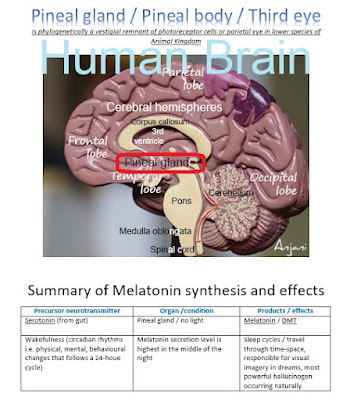
Pineal gland, the mystical third eye

Pineal gland   It is a very small unpaired midline brain structure of endocrine gland, tiny as a rice grain size, situated laterally (anatom...