Thursday, January 26, 2023

Sleep, neuronal activity and thrombotic events

Sleep stages & autonomic nervous system:
1. NREM sleep:
    1. Parasympathetic drive increases.
    2. Decline in Sympathetic drive, blood pressure, heart beat.

2. REM sleep:
    1. Profound Sympathetic nerve activity (increase).


Autonomic Nervous System, regulates involuntary physiologic processes like heart rate, blood pressure, respiration, digestion, sexual arousal etc. This is part of peripheral nervous system, comprising of Sympathetic, Parasympathetic and Enteric nervous system.

1. Sympathetic N.S.
    1. Afferent fibers -- Sensory input. 
                                                           } Central Nervous System
    2. Efferent fibers -- Motor output. }        ---->           motor pathway with 2 neuron series;
                                                                                       1. a Preganglionic neuron with a cell body in                                                                                                                         CNS.                                                                                                                                                                          
                                                                                       2. a Post ganglionic neuron with a cell body in 
                                                                                           the periphery that innervates target tissues. 

2. Parasympathetic N.S. 
    1. Afferent fibers -- Sensory input. 
                                                           } Central Nervous System
  2. Efferent fibers -- Motor output. }       ---->              1. S.N.S. activation
                                                                                           SNS innervates every every tissue in the body.
                                                                                           causes:
                                                                                           Elevated activity & attention.
                                                                                           "flight or fight" response,
                                                                                           b.p. & hear rate increases,
                                                                                           glycogenolysis ensues,
                                                                                           gastrointestinal peristalsis cease.

                                                                                        2. P.N.S. activation,
                                                                                            PNS innervates only the head, viscera,
                                                                                            external genitalia (smaller than SNS).
                                                                                            promotes: 
                                                                                            "rest & digest" response,
                                                                                            b.p. & heart rate lower,
                                                                                            gastrointestinal peristalsis/digestion restarts,

  • Presynaptic neurons of both SNS and PNS utilize acetylcholine(ACh) as neurotransmitter.
  • Postsynaptic Sympathetic neurons generally produce norepinephrine (NE) as their effector transmitter to act upon target tissue while Postsynaptic Parasympathetic neurons use ACh throughout.
  • Enteric neurons use several neurotransmitters as ACh, Nitrous Oxide, Serotonin etc.
      Neurotransmitter, are chemical signals from one neuron to the next target cell, to quote a few:
  • Acetylcholine is often used in Parasympathetic N.S. to have an inhibitory effect.
  • Norepinephrine (Noradrenaline; neurotransmitter and a hormone as well) often works with Sympathetic N.S.to have a stimulating effect on the body.

1  S.N.S. activation > increasing blood flow > decreasing food processing in the bowels > in turn would increase blood availability for genital engorgement.
2. P.N.S. activation > branches from Sacral plexus of Spinal nerves > arteries supplying erectile tissues. Nerves release Acetylcholine > Nitric Oxide from endothelial cells of trabecular arteries, eventually causes Nocturnal Penile tumescence. This NPT phenomena is of spinal regulation, brain or testosterone is not involved.

Sympathetic activity and REM sleep:
A research conclusion thankfully quoted here as, "REM sleep is associated with profound sympathetic activation in normal subjects, possibly linked to changes in muscle tone. The hemodynamic and sympathetic changes during REM sleep could play a part in triggering ischemic events in patients with vascular disease.


REM sleep is most manifest toward the end of sleep, before arousal. Sympathetic and hemodynamic alterations during REM sleep could conceivably initiate increased platelet aggregability, plaque rupture, or coronary vasospasm, thus acting as a triggering mechanism for thrombotic events that may present clinically only after arousal."

Tuesday, January 24, 2023

Brain waves, sleep stages and functional pathology

Brain waves are oscillating electrical voltage in the brain. Brain does not operate with any single frequency wave. Full spectrum of all brain wave frequencies are always there to be found. Only the dominant frequency determines our mental state.
EEG (Electroencephalogram) reveal their following types:

Frequency band    Frequency      Brain state              Notes
1. Gamma (γ)        35-44Hz    Concentration             High-level information processing is a 40 Hz
Problem solving,                                                          activity, 40 Hz deficiency creates learning
concentration.                                                               disability. Only a quiet mind access Gamma.
                                                                                      Gamma relates to expanded consciousness,                                                                                                                   spiritual emergence, higher virtues.

2. Beta (ß)              12-35 Hz     Anxiety dominant,    Normal dominant rhythm in alert, anxious, open
Busy,                                           active, external          eye, listening, thinking, judgment, processing  
active mind.                                attention, relaxed       information around us.

3.Alpha (α)            8-12 Hz          Very relaxed,          8-13 Hz, a bridge from external world to internal
Reflective,                                  passive attention        world, ability to shift states from external to 
restful.                                                                           internal and vice versa.
                                                                                     Our brain uses 13 Hz (high Alpha or low Beta)
                                                                                     for 'active' intelligence. Deficiency of 13 Hz
                                                                                     activity causes learning disability & attention
                                                                                     problem.
                                                                                      } Alpha-theta protocol, hypnogogic imagery.
4. Theta (θ)             4-8 Hz       Deeply relaxed,            
Drowsiness.                                 inward focused

4. Delta (δ)            0.5-4 Hz          Sleep                       Slowest wave
Sleep,
dreaming.


Sleep and brain waves:
  1. During sleep stages, brain waves vary from alpha to theta to delta and again to alpha state to complete one cycle of 90 minutes.
  2. 8-13 Hz frequency range of Alpha wave is a bridge from external world to the internal world, (A frequency range having ability to shift from external to internal world and vice versa).
  • Sleep stages N1 to N3 of NREM are 'slow' waves.
  • N1 and N2 mainly comprising Theta wave while N3 is deep Delta wave.
  • REM sleep is of 'fast' Alpha rhythm.


Sleep stage and their frequency:
Sleep stage       Voltage and frequency     Physiology                    
1. REM sleep    Low amplitude (small),      Eye movement, dream,    
                          high frequency (fast),        arm/leg muscles               
                           Alpha rhythm.                  paralyzed, respiration &
                                                                    heart beat maximum.

2. NREM sleep   High amplitude (large),    Slow wave, Deep-/Delta
    (N1 to N3)       (i.e. high voltage),            sleep, No eye movement,
                            low frequency (slow),       respiration & heart beat 
                            (i.e. slow waves),              minimal.
                            waves & spindles.
                            Theta & Delta rhythm.

Alpha rhythm dominant effects; 'Creative', daydreaming, meditating, helps reduce stress and anxiety, relaxed state, mental readiness role in focus and attention.
 
Theta rhythm dominant effects; Deep relaxation, light sleep, improves mood and reduce stress level.

Delta rhythm dominant effects; Deep sleep, improves immune system and reduce stress level, state of 'physical healing', tissue repair and regeneration.

Brain waves, cranial nerves & functional pathology:
Apart from sleep and wakeful activity, some other very interesting phenomenon occurs:
"A brain wave extends through perineural system as far as injured part of the body. This is physiological justification for the placebo effect as tissue repair, internal recovery, powerful vector of homeostasis." 
Positive attitude of patient plays a vital role in healing. A significant role of nerve manipulation have been reported in recovery, rehabilitation and rebalancing.


Tuesday, January 10, 2023

Sleep architecture

Sleep:
    EEG shows, sleep is a dynamic behavior, not a passive activity.
    Neuroendocrinological structures and chemicals responsible for sleep regulation are:
  • Sleep promoting neurons in anterior hypothalamus acts through cerebral cortex with neurotransmitters
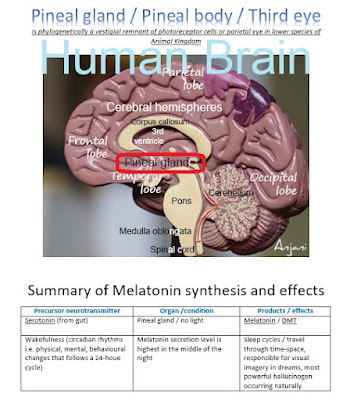
  • Sleep promoting hormone Melatonin produced in the pineal gland.
Sleep stages:
1. NREM sleep:
    No rapid eye movement.
    Restorative sleep, bodily recovery and growth
    Boosts immune system
    As you age, less NREM sleep
    N3 for insightful thinking and creativity.
2. REM sleep:
    Rapid eye movement.
    Essential to cognitive functions like memory, learning, creativity & vivid dreams.
    Deprived of REM sleep shortens life span.
    REM declines with growing age.

Sleep cycle:
    A hypnogram based on brain waves shows:
    1. 4-6 sleep cycles in a night.
    2. Each cycle last 90 minutes on average.
    3. Each cycle with 4 sleep stages;

Stage 1  NREM  N1       wake-sleep transition state                           1-5 mins          
Stage 2  NREM  N2       most of NREM sleep occurs in this stage   10-60 mins      
Stage 3  NREM  N3       slow wave-, delta-, deep sleep                     20-40 mins     
Stage 4   REM   REM    active sleep                                                    10-60 mins     

               N1, N2, N3 amounts 75%, while REM amounts 25% of all sleep.

Some other terms used, less often:
  1. Core sleep: Slow wave sleep, mainly N2 and Deep sleep N3.
  2. Optional sleep: rest of the sleep is grouped as Optional.


Wednesday, August 18, 2021

Monoclonal antibody treatment for Covid-19

Monoclonal antibody
They are the lab made protein, mimicking the natural immune system of the human body, to fight any infection like SARS-CoV-2. It is advised as to avoid hospitalization while being found with the positive Covid test.


Restrictions
It is restricted to people of 65 or more years in age. So fairly the Covid-19 patients are always asked to get tested quickly and then get advise for the treatment of monoclonal antibody infusion.

FDA has also now advised for the monoclonal antibody treatment for SARS-CoV-2 in a recent FDA news release. One can see the list of qualification for the Monoclonal antibody treatment on certain website of hospital.

More recommendations
"It's the best treatment we have to keep you out of the hospital. It keeps people out of the hospital 70 percent of the time," said Montgomery-area pulmonologist Dr. David Thrasher. "It's really a great treatment and everybody needs to ask for it."

Sunday, August 15, 2021

The fifth nucleobase

Basic ingredient in genetic recipe
Four letter A,T,C,G of genetic alphabet forming three letter words (codon), specifying for 20 amino acids, makes the basic molecular foundation of all life forms. 
But some viruses show a fundamental genomic change, a modified novel fifth base in nucleotide.

Z genome with a noncanonical modified base
In a strategy to escape bacterial restriction enzyme, it was found in the genome of  200 phage virus like one as cyanophage S-2L, out of the four canonical Watson-Crick nucleobases A,T,C,G; A is replaced by the diaminopurine (Z) forming three hydrogen bonds with T, which makes it more stable and rigid from bacterial defenses than double bond A=T. It was first reported in 1977 by soviet researcher. Further study suggest that aminoadenine in place of adenine was included in the phylogeny of these bacteriophage since archaic.
Jordana Cepelewicz in her article further states that: 'Z and other modified DNA bases seem to have evolve to help viruses evade the defenses with which bacteria degrade foreign genetic material. The eternal arms race between bacteriophages and their host cells probably provides enough selection pressure to affect something as seemingly "sacrosanct" as DNA, according to Romesberg.'

Thursday, August 12, 2021

Fear memories and neuronal disorders

Rapid gene expression and DSBs
In a research study, it was found that the neuronal activity induced DNA double strand breaks (DSBs) to cause a change in neuronal activity regulated genes, when an organism is exposed to new sensory experience due to change in organism's external environment. That is a process of quick access to store genetic instructions as store memories.
Neuronal damage
But Li-Huei Tsai, the Picower professor of neuroscience found in her lab studies that fear memories induced repeated DSBs causes severe neuronal damage results neurological diseases causing neurodegenerative disorders impacting learning and memories. As routinely repair process of breaks become flawed and fragile with age, as repair mechanism falters.

In a research article Aging brain initiative, Tsai says, "We wanted to understand exactly how widespread and extensive this natural activity is in the brain upon memory formation because that can give us insight into how genomic instability could undermine brain health down the road," "Clearly, memory formation is an urgent priority for healthy brain function, but these new results showing that several types of brain cells (including Glia called astrocytes), break their DNA in so many places to quickly express genes is still striking." It was found that Glia DSBs response to hormone glutocorticoids, secreted in response of stress in fear conditioning, shows robust transcriptional response of glia to stress through hormone.

Brain sites of fear memories 
Author in their study found that creation of fear memories doubled the number of DSBs in variety of cell types in prefrontal cortex and hippocampus regions essential for formation and storage of conditioned fear memories, affecting more than 300 genes in each region for making synaptic connections due increased transcriptionally induced loci, a phenomenon called 'synaptic plasticity'. So such new groups of neurons connected together cause formation of new memories, called engrams. 
 
Damages due to frequent DSBs
The researchers wrote, 'Overall we have identified sites of DSBs at genes important for neuronal and glial functions, suggesting that impaired DNA repair of these recurrent DNA breaks which are generated as part of brain activity could result in genomic instability that contribute to aging and disease in the brain'.

*This blog is inspired by the MIT news from Picower institute for learning and memory. Many more research paper links are also thankfully inserted in blog, from public domain publication for detail study if needs. Graphic is by blog author.

Saturday, August 7, 2021

Father of nuclear bomb and Sanskrit scripture Bhagavat-Gita

"I have always been curious to know the inspiration behind those brains of key nuclear physicist, working in the 'Manhattan Project' in 1945, resulting in nuclear bomb then code named 'Gadget'.

And here comes a book, from the 'Hindu' scripture 'Bhagavat-Gita', which 'Oppenheimer' quoted before and after the 'Trinity test', many a time.

Hard it is to conclude if the 'Gita' was/is a book inspiring for a decisive fight against enemy or a truce resulting after the war of such a ferocious magnitude.

What an irony, the war referred in this scripture was finally fought with 'Brahmastra', a name in 'Sanskrit', believed to be a nuclear weapon of that time." 
--Author 
(Storyline: J. Robert Oppenheimer/ Nuclear bomb/ Inspiration/ Bhagavat-Gita/ Indology)


July 16th:
Every year this date reminds us about first nuclear detonation, code named 'Trinity' (assigned by Oppenheimer), tested successfully in 1945 on the culmination of 'Manhattan Project' which later used against humans in shorter than a month time, i.e. 6th August 1945 on Hiroshima, killing 126,000 civilians instantly.


It is recorded that more than 130,000 strong human force were employed in this Nuclear weapon research project, secretly conducted at various sites in US, Canada and UK, in the World War II years ranging from 1942 to 1946.


What an irony:
1. The German chemists were the pioneer scientist namely Otto Hahn and Fritz Strassmann discovering Nuclear fission which theoretically explained by Lise Meitner and Otto Frisch. 

But it was the party opposite to use this technology to win and end the second world war lastly.

2. Those who were involved in the Project may not be knowing the full impact of destruction it was going to cause and whole concept of war and peace was going to change there on.

3. It is said that two days before the 'Trinity' test, Oppenheimer expressed his hope and fear by citing a quote from the Hindu scripture Bhagavat-Gita, as: "In battle, In the forest, at the precipice in the mountains, On the dark great sea, in the midst of javelins and arrows, In sleep, in confusion, in the depths of shame, The good deeds a man has done before defend him."

4. Later in 2016 US President Barack Obama was in Hiroshima, recalled; "Death fell from the sky and the world was changed" where 80,000 lives were lost instantly on 9th August 1945 as the second Nuclear bomb was dropped over Japan.

That reminds the warning wordings of then President Truman saying, "expect a rain of ruin from the air, the like of which has never been seen on this earth."

Julius Robert Oppenheimer: (Physicist and Professor at the University of California Berkeley)
Oppie, as his friends called him, the war time head of the Los Alamos laboratory, was among many who worked in the 'Manhattan Project', he is the one credited as the 'Father of the Atomic bomb.'

While witnessing the 'Trinity' explosion he thought about a verse from a Hindu scripture Bhagvat Gita (XI, 12): "If the radiance of a thousand suns were to burst at once into the sky, that would be like the splendor of the mighty one.."

His Gita connection: 
It was way back in 1933, much before the 'Manhattan Project', Oppenheimer, a Jewish by birth, learned Sanskrit from an Indologist, Professor Arthur W. Ryder at Berkeley, read Gita in Sanskrit. Later he recalled that this was the book that shaped his philosophy of life.


Oppenheimer persuaded to quote again for a television broadcast in 1965:
"We knew the world would not be the same. A few people laughed, a few people cried. Most people were silent. I remembered the line from the Hindu scripture, the Bhagavad-Gita (verse 32 of chapter 11). Vishnu is trying to persuade the Prince that he should do his duty, and, to impress him, takes on his multi-armed form and says, 'Now I am become death, the destroyer of worlds.' I suppose we all thought that, one way or another."

Link for text, translated-audio, Oppenheimer's video:
http://www.bhagavad-gita.org/Gita/verse-11-30.html

'Bhagvat-Gita' scripture showing page with a verse 11-30, with an English translation by Oppenheimer, which is being quoted more often.


Life after: 
As quoted by author Robert Monk in his book, Oppenheimer reportedly told the then President Truman on October 25, 1945: "Mr.President, I feel I have blood on my hands."

Such was the sorrow !
it enveloped everyone !! 
even those who created it !!!

*A related article by the author:

Pineal gland, the mystical third eye

Pineal gland   It is a very small unpaired midline brain structure of endocrine gland, tiny as a rice grain size, situated laterally (anatom...