Thursday, August 12, 2021

Fear memories and neuronal disorders

Rapid gene expression and DSBs
In a research study, it was found that the neuronal activity induced DNA double strand breaks (DSBs) to cause a change in neuronal activity regulated genes, when an organism is exposed to new sensory experience due to change in organism's external environment. That is a process of quick access to store genetic instructions as store memories.
Neuronal damage
But Li-Huei Tsai, the Picower professor of neuroscience found in her lab studies that fear memories induced repeated DSBs causes severe neuronal damage results neurological diseases causing neurodegenerative disorders impacting learning and memories. As routinely repair process of breaks become flawed and fragile with age, as repair mechanism falters.

In a research article Aging brain initiative, Tsai says, "We wanted to understand exactly how widespread and extensive this natural activity is in the brain upon memory formation because that can give us insight into how genomic instability could undermine brain health down the road," "Clearly, memory formation is an urgent priority for healthy brain function, but these new results showing that several types of brain cells (including Glia called astrocytes), break their DNA in so many places to quickly express genes is still striking." It was found that Glia DSBs response to hormone glutocorticoids, secreted in response of stress in fear conditioning, shows robust transcriptional response of glia to stress through hormone.

Brain sites of fear memories 
Author in their study found that creation of fear memories doubled the number of DSBs in variety of cell types in prefrontal cortex and hippocampus regions essential for formation and storage of conditioned fear memories, affecting more than 300 genes in each region for making synaptic connections due increased transcriptionally induced loci, a phenomenon called 'synaptic plasticity'. So such new groups of neurons connected together cause formation of new memories, called engrams. 
 
Damages due to frequent DSBs
The researchers wrote, 'Overall we have identified sites of DSBs at genes important for neuronal and glial functions, suggesting that impaired DNA repair of these recurrent DNA breaks which are generated as part of brain activity could result in genomic instability that contribute to aging and disease in the brain'.

*This blog is inspired by the MIT news from Picower institute for learning and memory. Many more research paper links are also thankfully inserted in blog, from public domain publication for detail study if needs. Graphic is by blog author.

Saturday, August 7, 2021

Father of nuclear bomb and Sanskrit scripture Bhagavat-Gita

"I have always been curious to know the inspiration behind those brains of key nuclear physicist, working in the 'Manhattan Project' in 1945, resulting in nuclear bomb then code named 'Gadget'.

And here comes a book, from the 'Hindu' scripture 'Bhagavat-Gita', which 'Oppenheimer' quoted before and after the 'Trinity test', many a time.

Hard it is to conclude if the 'Gita' was/is a book inspiring for a decisive fight against enemy or a truce resulting after the war of such a ferocious magnitude.

What an irony, the war referred in this scripture was finally fought with 'Brahmastra', a name in 'Sanskrit', believed to be a nuclear weapon of that time." 
--Author 
(Storyline: J. Robert Oppenheimer/ Nuclear bomb/ Inspiration/ Bhagavat-Gita/ Indology)


July 16th:
Every year this date reminds us about first nuclear detonation, code named 'Trinity' (assigned by Oppenheimer), tested successfully in 1945 on the culmination of 'Manhattan Project' which later used against humans in shorter than a month time, i.e. 6th August 1945 on Hiroshima, killing 126,000 civilians instantly.


It is recorded that more than 130,000 strong human force were employed in this Nuclear weapon research project, secretly conducted at various sites in US, Canada and UK, in the World War II years ranging from 1942 to 1946.


What an irony:
1. The German chemists were the pioneer scientist namely Otto Hahn and Fritz Strassmann discovering Nuclear fission which theoretically explained by Lise Meitner and Otto Frisch. 

But it was the party opposite to use this technology to win and end the second world war lastly.

2. Those who were involved in the Project may not be knowing the full impact of destruction it was going to cause and whole concept of war and peace was going to change there on.

3. It is said that two days before the 'Trinity' test, Oppenheimer expressed his hope and fear by citing a quote from the Hindu scripture Bhagavat-Gita, as: "In battle, In the forest, at the precipice in the mountains, On the dark great sea, in the midst of javelins and arrows, In sleep, in confusion, in the depths of shame, The good deeds a man has done before defend him."

4. Later in 2016 US President Barack Obama was in Hiroshima, recalled; "Death fell from the sky and the world was changed" where 80,000 lives were lost instantly on 9th August 1945 as the second Nuclear bomb was dropped over Japan.

That reminds the warning wordings of then President Truman saying, "expect a rain of ruin from the air, the like of which has never been seen on this earth."

Julius Robert Oppenheimer: (Physicist and Professor at the University of California Berkeley)
Oppie, as his friends called him, the war time head of the Los Alamos laboratory, was among many who worked in the 'Manhattan Project', he is the one credited as the 'Father of the Atomic bomb.'

While witnessing the 'Trinity' explosion he thought about a verse from a Hindu scripture Bhagvat Gita (XI, 12): "If the radiance of a thousand suns were to burst at once into the sky, that would be like the splendor of the mighty one.."

His Gita connection: 
It was way back in 1933, much before the 'Manhattan Project', Oppenheimer, a Jewish by birth, learned Sanskrit from an Indologist, Professor Arthur W. Ryder at Berkeley, read Gita in Sanskrit. Later he recalled that this was the book that shaped his philosophy of life.


Oppenheimer persuaded to quote again for a television broadcast in 1965:
"We knew the world would not be the same. A few people laughed, a few people cried. Most people were silent. I remembered the line from the Hindu scripture, the Bhagavad-Gita (verse 32 of chapter 11). Vishnu is trying to persuade the Prince that he should do his duty, and, to impress him, takes on his multi-armed form and says, 'Now I am become death, the destroyer of worlds.' I suppose we all thought that, one way or another."

Link for text, translated-audio, Oppenheimer's video:
http://www.bhagavad-gita.org/Gita/verse-11-30.html

'Bhagvat-Gita' scripture showing page with a verse 11-30, with an English translation by Oppenheimer, which is being quoted more often.


Life after: 
As quoted by author Robert Monk in his book, Oppenheimer reportedly told the then President Truman on October 25, 1945: "Mr.President, I feel I have blood on my hands."

Such was the sorrow !
it enveloped everyone !! 
even those who created it !!!

*A related article by the author:

Thursday, August 5, 2021

Hiroshima, Nagasaki in ethical perspective of nuclear bomb creator

"Out of curiosity, I have always thought about the minds of scientists working 76 years back in 'Manhattan project' then in 1948 and whose labor was materialized in less than a month time after 'Trinity' test, into a man hunting arsenal causing massacre at large in Hiroshima and Nagasaki on 6th and 9th August 1945, culminating into the last bloodiest scar for humanity to remember for generations, if they do not learn any lesson from.

From their statements, some being quoted below for easy reference, one can easily conclude their utter frustration from this outcome with a collective sense of regret." 
--Author
(Storyline: Second world war/ Nuclear bomb/ Aesthetic and ethical judgement)

Life is lot more fragile than we think. So you should treat others in a way that leaves no regrets. Fairly, and if possible, sincerely. It's too easy not to make the effort, then weep and wring your hands after the person dies. 
--Haruki Murakami 

J. Robert Oppenheimer: 'We have made a very grave mistake', and 'in some sort of crude sense..the physicist have known sin.'

In a famous quote about his meet with President Henry Truman, he has said then, 'Mr. President, I feel I have blood on my hands.'
Well, then he was referring the future too.

Henry Wallace, then the Vice President, recalls about him in his diary, 'I never saw a man in such an extremely nervous state as OppenheimerHe seemed to feel that the destruction of the entire human race was imminent.'

Later he vocalize his fear by saying, 'the people of this world must unite or they will perish.'

Reminiscing his earlier days while working in Los Alamos Laboratory, 'To me (the task at hand) is primarily the development in time of war of a military weapon of some consequences,....concern was as if to save the civilization.'

Perhaps when he referred through his famous quote of the Gita after the Trinity test:   'I am become deaththe destroyer of the worlds,' ..was perhaps pointing his concern for humanity in posterity.

Albert Einstein: He did not play a direct role but his discoveries did and he was in regret for the letter he wrote to Roosevelt . 'Had I known that the Germans would not succeed in producing Atomic bomb', he said, 'I would have never lifted a finger.'

In 1954, 5 months before his death, he has said, 'I made one great mistake in my life ..when I signed the letter to President Roosevelt recommending that atom bombs be made.'

'Politics is more difficult than physics', was the answer of Albert Einstein when he was asked, why one can discover the atomic power and not to control it.

Sunday, August 1, 2021

CRISPR-Cas9 gene editing tool can cause chromothripsis leading to oncogenes

CRISPER-Cas9 an ancient immune system in bacterium
Microbiologist in 1993 identified some unique repetitive, well preserved DNA sequences in Prokaryotes, appearing over and over again. Between repetitive  DNA sequences there are unique sequences that differs. These repetitive sequences are called as 'clustered regularly interspaced short palindromic repeats', abbreviated as CRISPER. Those non repetitive sequences matches with the genome of their pathogenic phage viruses. "So the hypothesis were put forward that bacterium succeeded in surviving from the virus infection by adding a piece of virus genetic code into it's genome as the memory of the infection. Perhaps the mechanism used by bacterium to neutralize a virus is by RNA interference." These were named as trans-activating crispr RNA (tracrRNA). That's an ancient immune system that protects bacterium from the infection of viruses.

Genetic scissor
Emmanuelle Charpentier and Jennifer Doudna, found that apart from CRISPER there are special CRISPER associated (cas9) genes, known for coding of a protein which unwinds and cleaves DNA (perhaps for the virus genetic material). Both scientists realized that the CRISPER-cas9 system could be programmed to cut other pieces of DNA and were awarded Nobel Prize 2020 in Chemistry "for the development of a method for genome editing". This precise molecular tool, like a scissor to make precise incision in DNA , to rewrite the code of life i.e. the genetic material.

Emmanuelle (left) and Jennifer (right)
Thankfully shared from Nobel Media in public domain

It also raises ethical, social and safety concerns as it's controversial use on human cells. This genetic scissor opened a new era of possibilities in the field of life sciences, biochemistry, cell biology, like as a gene editor, knowing the functions of genes and editing them for desired characters in plant breeding or controlling hereditary diseases etc.

CRISPER-Cas9 and genotoxicity
CRISPER-Cas9 based therapies have reported many genotoxic incident causing clinical complications like large scale DNA deletionsp53 tumor suppressor proteinchromosomal truncationspreexisting antibodies and T cells induced problems.

This happens because in clinical applications the possible safety concern and care are not being taken, resulting in break of d-DNA that results in genomic rearrangement, that means individual arrangement of chromosome is shattered which may also result in subsequent rejoining in haphazard order.

It is found that mostly cells do not survive due to these alterations and if they do, then may result in oncogenic fusion proteins or dysregulated expression of a particular gene that may bring more unwanted complications in individual cell.

Monday, July 26, 2021

'Code in Place', a computer coding course in Covid time

Learning during a grim phase of Covid Delta wave in India 
My log in page
When India was simmering with Delta wave of Covid-19, deaths were reported everywhere from one's neighbor to distant places, medical/social assisting system of every kind was disrupted completely, human dignity touched it's lowest point in our recent history; we sat in our homes with doors and windows closed and  mask on, isolating self in rooms possibly available, as if 'Covid-19 was in the air'. Hardly there was any home left where the family members were not with viral infective symptoms of some kind. People ran from one medical store to other in search of counter top medicine of some sort as there was no one to prescribe or guide to. This peak period ranged from mid April to the end of the May 2021. It was a period when 'Code in Place' came as rescue & refuge for many of us, here in India.

Shelter in Place vs Code in Place 2021 
OhYay for virtual Section
Phrase well suited to the situation when we all needed 'Shelter in place' and Stanford University provided us with 'Code in Place'. One can hardly imagine that how beneficial it was to us to engage us mentally for hours without any Covid-19 fear or isolation pressure from rest of our world. I sat transfixed to computer monitor, pouring attention to, unaware to the grim world outside, in my room at least for that much of the period. Thank you to all the distinguished team members of Stanford University for saving us from the rigorous pressure of the Covid Delta wave with unique opportunity of learning as well, a new skill set.

Coding in Places
Screenshot of a lecture video by Prof Mehran Sahami
It was a computer course in learning for coding and programming for Python language, based on Stanford University's CS106A, like the one they had in previous year in peak Covid-19 time of 2020. This was an online course, conducted for five weeks duration, requiring at least 10 hours per week, from April 19th to May 28th, 2021.


Karel commands from Karel Reader
For me it provided an unique experience of learning Coding in computer language Python. Each week with 3 days lecture videos, 1 day for 1 hour Section teaching, learning, problem solving activity with assigned  Section Leader of a Section around 10 students. Every week there were due assignments to solve and submit in due period. 'Karel' robot for initial learning of Python language, 'Ed' an online IDE hosting CIP community, 'OhYay' access for live Section for 1000+ section meetings around the clock across the globe engaging in virtual experiences were a huge shoutout. Hangout campfire by Section leaders was so useful to sort out and debugging of code written by any individual. Handouts, Lecture Videos, Lecture Slides, Files are still there for 'Life after Code in Place'.

While working on PyCharm IDE


Teaching by Mehran Sahami, Chris Piech, Julie Zelenski was a life time experience for the Coding. 
Meeka's design was selected by voting 
My experience was that the 'Content delivery' in teaching is a crucial part in communicating learning; while 'content', 'resource' and 'language-medium' matters little.


  Learning Coding was like getting magical tool along with 12,000 students, 1125 Section Leaders from all across the globe in a Community Service gesture of Stanford University in the testing time of Covid-19.

Getting my final project published in the showcase of Code in Place 2021 was a real reward and a great opportunity of participation.

Thank you Mehran Sahami, Chris Piech, Julie Zelenski, Brahm Capoor and many more in the entire team of this project at Stanford University, expanding in all 7 continents and countries.

Map of Code in Place 2021, thankfully shared from 

Sunday, July 18, 2021

Genetic code, Codon, Anti Codon, expression in Translation and Laws of heredity

--------------------------------------   
Basic molecular code of life:
--------------------------------------
Genes on Chromosome in the cell nucleus carry instructions for amino acids in the form of chemical alphabets. They are four nitrogenous bases: A, G, T, C; namely Adenine, Guanine, Thymine, Cytosine. U (Uacil) is found only in RNA, replacing T. 

These 4 nucleotides (A, G = Purines; T, C = Pyrimidines) of the DNA combine in various ways to form 3 letter code for any specific amino acid to the synthesis of protein.

Making of protein: Gene expression for the synthesis of protein is in two ways:

1. Transcription: Gene sequence of DNA strand is rewritten on mRNA with the help of transcriptase enzyme inside nucleus of the cell.

2. Translation: mRNA Nucleotide sequence is rewritten on tRNA with the help of polymerase enzyme, which in turn picks up a specific amino acid to form a polypeptide in Ribosome of the cell.

We encounter Codon and Anti Codon at the time of Translation.

Codon: A sequence of 3 nitrogenous Bases in a row on mRNA, as a message for the specific Amino acid.

Anti Codon: A sequence of 3 nitrogenous Bases in a row on tRNA on it's anti codon loop. They also have pseudo bases apart from the regular bases. These codon recognize the correct codon on mRNA by its complementary sequence.

Amino acid activation:
Amino acid + ATP --------> Amino acyl AMP +2Pi
Amino acyl + tRNA  --------> Amino acyl tRNA +AMP
                                               (tRNA loaded with Amino acid)
                                                   (cognate or charged tRNA)
Correct amino acid recognisation here by tRNA base (3' 5'), with complementary match with the base sequence on mRNA (5' 3').           

-----------------------                                       
Code crackers:
-----------------------
1. Physicist George Gamow in mid 1950s proposed the triplet hypothesis, this insight was mathematically suitable to code for essential 20 amino acids. 
This three nucleotide triplet code was the minimum to cover all the amino acids, later proved correct.
2. American biochemists Marshall W. Nirenberg, Robert W. Holley, Hargobind Khorana in 1960s did the pioneering work.
Nirenberg in 1961 with mRNA consisting poly-U, synthesized Phenylalanine (concluding UUU code for Phenylalanine) and later with poly-C mRNA translated to Proline (concluding CCC code for Proline).
Later Khorana experimented with poly-UC mRNA generated Serine and Leucine (concluding UCU code for Serine and CUC for Leucine).
In 1965 this code researcher  team deciphered the entire genetic code, including stop code, initiation code and received Nobel Prize in 1968.
(above modified image from nobel.org, in public domain)

----------------------------------------------------------------------------
Gregor Johann Mendel (1822-1884), Father of Genetics
-----------------------------------------------------------------------------
Mendel (Czech) did his experiments on 10,000 pea plants for eight years (1856-1863), published his results in 1865. He concluded that genes come in pair and inherited as distinct units, one from each parent. He tracked the segregation of parental genes and their appearance as dominant or recessive traits in offspring.
He clearly recognized the mathematical pattern of inheritance from one generation to the next.
Mendel's Laws of Heredity are:
1, The Law of Segregation,
2. The Law of Independent Assortment,
3. Law of Dominance.
After his death, most of his personal papers and documents were burnt by the monks except few which remained in the archive of monastery.
Mendel on a postal stamp
      His laws were not understood until 1900 when independently three Botanist namely Hugo de Vries (Netherland), Correns (Germany) and Tschermak (Austria) rediscovered the findings of Mendel. 
      So Mendel put a blue print of things to come in the field of Genetics by deducing the laws of inheritance. 

       Meiosis, Chromosomes, Crossing Over, Genes, Linked Genes, Triplet Code were unknown in his time but his finding explains all this. His experimental results were rediscovered 16 years after his death and 34 years after he first published it. Triplet code came to be known only 100 years after his publication. Such was his genius as if he foresee all that. A friar, abbot who became 'Father', leaving no descendants behind, died at the age of 61 due to kidney ailment.

Monday, July 12, 2021

Reverse Transcriptase Polymerase Chain Reaction for Covid-19 and Zika testing

PCR 
Polymerase Chain Reaction is an in vitro diagnostic technique. This is being used to amplify the DNA or RNA sequence of any source material. 
In the PCR process a target DNA sequence and DNA Polymerase enzyme is used in lab conditions, usually passing with following cycles in stages:
1. Converting dsDNA to single stranded DNA,  
2. formation of new dsDNA  with one old strand and one new strand,
3. using new dsDNA as an template to for synthesis in next cycles.

RT-PCR 
Reverse Transcriptase Polymerase Chain Reaction is also an in vitro diagnostic technique with a variation of PCR. In this process a mRNA sample with reverse transcriptase enzyme, a cDNA copy is obtained. Here onward a standard PCR process is followed in sequence to obtain the dsDNA sequence. 
RT-PCR and Covid-19 
Often RT-PCR is combined with the real time PCR (qRT-PCR) to quantify the transcript levels in cells/tissues.
Originally radioactive isotopes were used in this nuclear derived method; now replaced by the isotopic labelling with special markers like fluorescent dyes.
Conventional RT-PCR allows to see the result at the end of the process while in qRT-PCR one can see result immediately while the process is still on going. This technique has been used successfully in diagnosing Ebola and Zika virus and is now adapted for testing the Covid-19 virus.

Further reference for:

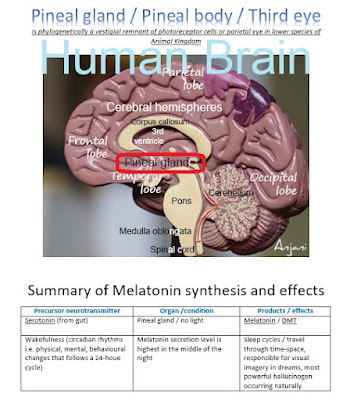
Pineal gland, the mystical third eye

Pineal gland   It is a very small unpaired midline brain structure of endocrine gland, tiny as a rice grain size, situated laterally (anatom...